What is Earned Value Management (EVM)? Definition, Key Figures, Advantages and Limitations

In the dynamic field of project management, those responsible are constantly seeking methods to objectively assess progress, keep costs under control, and reliably adhere to schedules. One of the most established and meaningful techniques for this purpose is Earned Value Management (EVM). This method offers an integrated approach to measuring project performance by combining project scope, schedule, and cost into a single system. EVM quantifies performance by comparing planned progress with actual progress, based on measurable units such as costs or labor hours. The core concepts include Planned Value (PV), Earned Value (EV), and Actual Cost (AC). Applying EVM comes with numerous benefits, such as improved forecasting accuracy and an effective early warning system. However, it also involves challenges and limitations, such as implementation effort.
The origins of Earned Value Management date back to the 1960s, when the U.S. Department of Defense (DoD) was looking for ways to improve control over complex large-scale projects such as the Polaris missile program. This led to the development of the Cost/Schedule Control Systems Criteria (C/SCSC), which were later developed into the industry standard ANSI/EIA-748. EVM works both diagnostically—answering the question "Where do we stand?"—and prognostically—providing insight into "Where are we going?". It is therefore an indispensable tool for project control and risk management.
Table of contents
- What is Earned Value Management (EVM)?
- What are the key concepts of Earned Value Management?
- How is performance measured with Earned Value Management?
- What are the advantages of Earned Value Management?
- What are the limitations and boundaries of Earned Value Management?
- Earned Value Management vs. other project methods
- Project management software for Earned Value Management
- Conclusion: Why Earned Value Management remains a powerful tool for project managers
What is Earned Value Management (EVM)?
Earned Value Management (EVM), also known as Earned Value Project Management (EVPM) or Earned Value Performance Management, is a comprehensive project management method that integrates project scope, schedule, and the resources used (costs) in order to objectively measure and control project performance against an established baseline (performance measurement baseline). The core principle of EVM is that the value of the actually completed work—the so-called Earned Value (EV) — corresponds to the budgeted cost for that specific work. This EV is often referred to as Budgeted Cost of Work Performed (BCWP) and is a central pillar of the method.
The development of EVM by the U.S. Department of Defense in the mid-1960s was a response to the need to manage complex and costly programs more effectively. Originally designed for large-scale projects like the Polaris program, it was based on the Cost/Schedule Control Systems Criteria (C/SCSC), a set of 35 criteria aimed at ensuring disciplined planning and control. Subsequently, the method spread to other U.S. government agencies such as NASA and the Department of Energy (DOE). Later, EVM also gained acceptance in the private sector, particularly in industries such as construction, IT, and manufacturing. The inclusion and prominence of EVM in the PMBOK® Guide of the Project Management Institute (PMI) underscores its global recognition as a best practice in project management.
The longevity and continued relevance of EVM—with more than 50 years of proven application—is largely due to its focus on fundamental management criteria and guidelines rather than rigid, prescriptive tools or software. This flexibility allows organizations to adapt EVM to their specific needs, processes, and project sizes and to integrate it into existing management systems.
What are the key concepts of Earned Value Management?
To apply Earned Value Management effectively, a clear understanding of its fundamental building blocks is essential. The core method of Earned Value Management is based on several key concepts that together provide a comprehensive picture of project performance:
- Planned Value (PV): The authorized budget assigned to the scheduled work.
- Earned Value (EV): The value of the work actually performed.
- Actual Cost (AC): The actual cost incurred for the performed work.
- Budget at Completion (BAC): The total planned budget for the entire project.
The true strength of the Earned Value Management concept lies not in viewing these values in isolation, but in comparing them. Comparing Earned Value (EV) with Planned Value (PV) provides insight into schedule performance, while comparing EV with Actual Cost (AC) reflects cost performance. These interrelationships allow for precise analysis and forecasting of project progress.
Planned Value (PV): The planned baseline
Planned Value (PV), also known as Budgeted Cost of Work Scheduled (BCWS), represents the authorized budget assigned to the work scheduled for completion by a specific date. It reflects the planned project progress in monetary units and forms the baseline against which actual performance is measured.
PV is derived directly from a detailed project plan that integrates scope, schedule, and cost. For each work package or activity in the work breakdown structure (WBS), planned costs are distributed over time. The sum of these planned costs up to a specific point in time results in the PV.
Calculation example: Assume a project task has a total budget of €1,000 and is planned to be 50% complete by the end of the current month. The Planned Value for this task at month-end is therefore €500 (€1,000 * 50%).
Earned Value (EV): The value of performed work
Earned Value (EV), also referred to as Budgeted Cost of Work Performed (BCWP), quantifies the value of the work actually completed up to a specific reporting date. It is expressed in the same monetary units as Planned Value and Actual Cost and thus represents the “value” of the completed work, based on the originally approved budget for this work.
Accurately measuring EV is crucial to the validity of the entire Earned Value analysis. Various methods for progress measurement exist for this purpose, known as “Earning Rules” or Earned Value techniques:
- Milestone method: Value is credited once defined milestones are reached.
- Weighted milestones/steps: Individual work package steps are assigned predefined weights (value shares).
- Physical percent complete: Progress is determined based on an objective estimate of the physical completion level (e.g., 3 out of 5 modules programmed = 60%).
- Fixed formulas:
- 0/100 rule: The entire value is credited only when the work package is fully completed.
- 50/50 rule: 50% of the value is credited at the start and the remaining 50% upon completion of the work package (variants like 20/80 or 25/75 are also common).
- Level of Effort (LOE): For supporting activities without directly measurable results (e.g., project management, quality assurance), EV is often set equal to PV.
The choice of the appropriate progress measurement method depends on the type of work and the desired accuracy. Objective and consistent measurement is essential for the integrity of Earned Value.
Actual Cost (AC): Actual expenses
Actual Cost (AC), also referred to as Actual Cost of Work Performed (ACWP), includes the total costs that have actually been incurred and recorded for the work performed during a specific time period. This includes all direct and indirect costs that can be attributed to the project or specific work packages, such as personnel costs, material costs, travel expenses, or external services.
AC data typically originate from the company’s project accounting, time-tracking, or financial systems. A significant challenge in capturing Actual Costs is ensuring proper timing. It is critical to ensure that AC data is aligned with EV reporting (i.e., the reporting date for performance measurement). Delays in cost recording or posting can lead to misleading performance indicators, as the reported performance (EV) would not correlate with the actually incurred costs (AC). Therefore, careful resource planning in project management and timely cost tracking are crucial.
Budget at Completion (BAC): Total planned project budget
Budget at Completion (BAC) represents the total planned budget for the entire scope of the project. It is the sum of all individual budgets for the work packages and activities defined in the work breakdown structure. BAC forms the original Performance Measurement Baseline (PMB) with respect to cost and serves as a fundamental reference point for evaluating the overall project.
BAC plays an important role in calculating total project variances, various performance indices, and especially in forecasting the expected final cost of the project, known as Estimate at Completion (EAC). Ideally, BAC should remain stable throughout the project life cycle. Changes to BAC are only justified if there are approved changes to the project scope. A solid cost plan in project management is the basis for a realistic BAC.

How is performance measured with Earned Value Management?
Once the key concepts PV, EV, AC, and BAC are established, various metrics can be derived from them to analyze project performance in detail and to generate forecasts for the remaining course of the project. These EVM metrics allow project managers to identify deviations at an early stage and to make well-founded decisions. In practice, certain key figures or their combinations have proven to be particularly meaningful early warning indicators. PLANTA Project, for example, provides visual evaluations of central EVM key figures on its Info Board, particularly for the Earned Value itself and for trends of SPI/CPI and SV/CV. These visualizations are based on the approved status reports and the valid baseline.
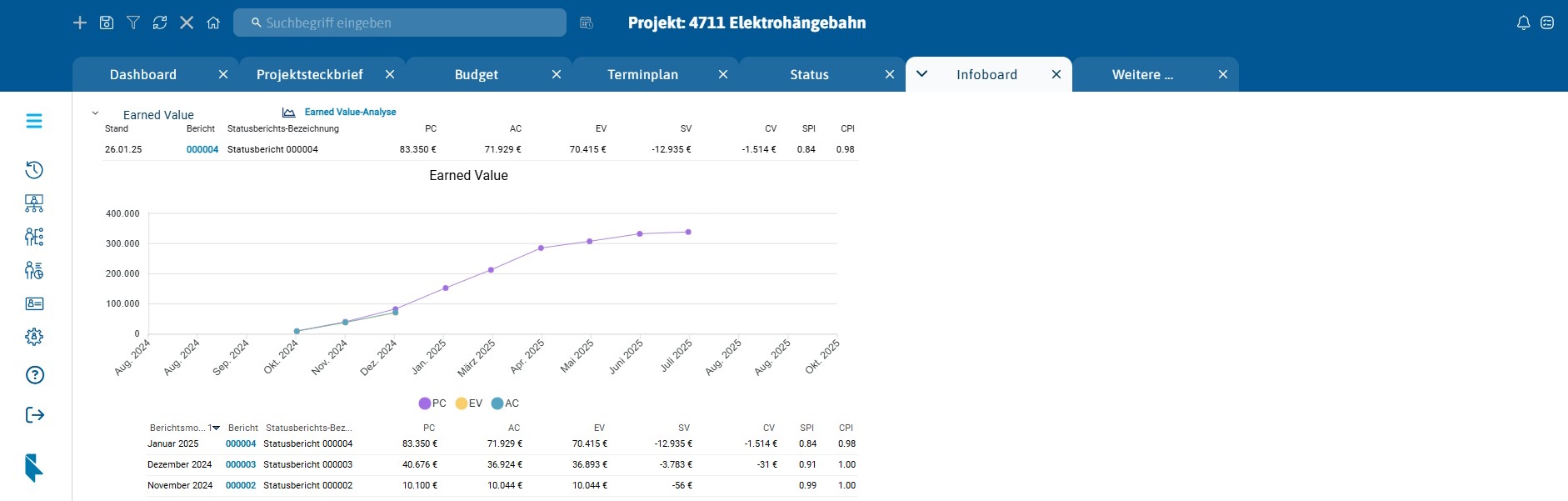
This graphical presentation in PLANTA Project allows the project management to identify negative developments – such as a continuously falling CPI below 1.0 – early on and address them immediately.
Although there are no fixed threshold values (such as CPI < 0.9) throughout the system, the visualization of trends over time supports effective interpretation and the identification of critical patterns. The To-Complete Performance Index (TCPI) is currently not visualized as a trend, but it can still be used as an important computed value in the context of other key figures for managing remaining effort.
The most important metrics for performance measurement with Earned Value Management include:
- Cost Variance (CV): Measures the deviation between actual costs and earned value. Formula: CV = EV − AC. A positive value means the project is under budget, a negative value means it is over budget.
- Schedule Variance (SV): Measures the deviation of earned value from the planned value in monetary units. Formula: SV = EV − PV. A positive value means the project is ahead of schedule, a negative value means it is behind schedule.
- Cost Performance Index (CPI): Measures cost efficiency. Formula: CPI = EV / AC. A value > 1.0 means better cost efficiency than planned, < 1.0 means lower efficiency.
- Schedule Performance Index (SPI): Measures schedule efficiency. Formula: SPI = EV / PV. A value > 1.0 means the project is progressing faster than planned, < 1.0 means slower.
- Estimate at Completion (EAC): Forecast of the expected total cost of the project upon completion. Example formula: EAC = BAC / CPI (if current efficiency is assumed to continue).
- Estimate to Complete (ETC): Forecast of the additional costs required to complete the project. Formula: ETC = EAC − AC
- Variance at Completion (VAC): Forecast of the variance from the total budget at completion. Formula: VAC = BAC − EAC
- To-Complete Performance Index (TCPI): Indicates the cost efficiency required for the remaining work to complete the project within a given budget (BAC or EAC). Formula (based on BAC): TCPI = (BAC − EV) / (BAC − AC)
Variance analysis with Cost Variance (CV) and Schedule Variance (SV)
Variance analyses are a core component of EVM and measure deviations from the plan in absolute monetary terms. They provide direct insights into whether a project is on track in terms of cost and schedule.
- Cost Variance (CV):
Formula: CV = EV – AC.- CV > 0: The project falls below the budgeted cost for the completed work (positive, favorable).
- CV < 0: The project exceeds the budgeted cost for the completed work (negative, unfavorable).
- CV = 0: The project is exactly on budget for the completed work.
A positive cost variance means that less cost has been incurred for the completed work than originally budgeted.
- Schedule Variance (SV):
Formula: SV = EV – PV.- SV > 0: The project is ahead of schedule (more work completed than planned).
- SV < 0: The project is behind schedule (less work completed than planned).
- SV = 0: The project is exactly on schedule.
Schedule variance is expressed in monetary units and represents the value of the deviation from the schedule. An SV of €10,000 means, for example, that work valued at €10,000 has not yet been performed, although it should have been completed according to the plan.
Performance indices with Cost Performance Index (CPI) and Schedule Performance Index (SPI)
While variances show absolute deviations, performance indices express efficiency as a ratio. They are particularly useful for comparisons over time, between projects or project phases, and serve as a basis for forecasting.
- Cost Performance Index (CPI):
Formula: CPI = EV / AC.- CPI > 1.0: The project is more cost-efficient than planned (e.g., CPI = 1.2 means €1.20 value earned per €1 spent).
- CPI < 1.0: The project is less cost-efficient than planned (e.g., CPI = 0.8 means €0.80 value earned per €1 spent).
- CPI = 1.0: The project is exactly as cost-efficient as planned.
The CPI is a critical indicator of a project’s financial health.
- Schedule Performance Index (SPI):
Formula: SPI = EV / PV.- SPI > 1.0: The project is progressing faster than planned.
- SPI < 1.0: The project is progressing slower than planned.
- SPI = 1.0: The project is exactly on schedule.
Although the SPI is a useful indicator, it comes with a limitation: near the end of the project, SPI tends to approach 1.0, regardless of whether the project will actually be completed on time (since PV and EV both approach BAC). For more robust schedule analysis, particularly in case of delays, the Earned Schedule (ES) concept is used, which measures schedule performance in time units.
Forecasting metrics with Estimate at Completion (EAC) and Estimate to Complete (ETC)
EVM not only enables the evaluation of past performance, but also supports well-founded forecasts regarding future cost development. The most important forecasting metrics are Estimate at Completion (EAC) and Estimate to Complete (ETC).
- Estimate at Completion (EAC): Forecast of total cost at completion
The EAC forecasts the expected total cost of the project based on past performance and specific assumptions about the future. Common formulas for calculating EAC include:- EAC = BAC / CPI: This formula is used when it is assumed that the current cost efficiency (CPI) will continue for the remainder of the project. It is often used as a standard formula.
- EAC = AC + (BAC – EV): This formula assumes that the remaining work will be performed at the originally planned cost—i.e., past inefficiencies will not have an impact on the future.
- EAC = AC + new estimate (Bottom-up ETC): In this case, the actual costs incurred to date (AC) are added to a new, detailed estimate of the remaining costs (ETC). This approach is most accurate when the project context has changed significantly.
- EAC = AC + (BAC – EV) / (CPI * SPI): This formula considers both cost and schedule efficiency for the forecast of remaining costs.
- Estimate to Complete (ETC): Forecast of remaining costs
The ETC indicates how much cost is expected to be required to complete the remaining project work. It can be calculated in various ways:- ETC = EAC – AC: This is the most common derivative, used once EAC is determined.
- ETC = (BAC – EV) / CPI: Used when it is assumed that the remaining work will be performed with the same cost efficiency as the work already completed.
- ETC = Neue Schätzung (Bottom-up): A detailed new estimate of the costs for all remaining tasks.
These EVM forecasting metrics are essential for stakeholder expectation management and for timely corrective action if the projected final cost of the project is expected to exceed the original budget.
Additional key indicators: Variance at Completion (VAC) and To-Complete Performance Index (TCPI)
Two more important indicators round out the picture of project performance and forecasting: Variance at Completion (VAC) and To-Complete Performance Index (TCPI).
- Variance at Completion (VAC): Deviation at project completion
The VAC forecasts the expected budget surplus or deficit at the end of the project. It is calculated as:- VAC > 0: The project is expected to be completed under the planned budget (positive).
- VAC < 0: The project is expected to exceed the planned budget (negative).
- VAC = 0: The project is expected to finish exactly on budget.
The VAC provides a clear statement about whether the project will meet its financial targets.
- To-Complete Performance Index (TCPI): Target cost performance index
The TCPI is a critical indicator that shows the required cost efficiency for the remaining work in order to achieve a specific financial goal, either the original budget (BAC) or the current forecast (EAC).- TCPI (based on BAC): TCPI = (BAC – EV) / (BAC – AC)
This formula indicates the cost efficiency required for the remaining work to meet the forecasted total cost (EAC). The TCPI serves as a “reality check”: if the required TCPI is significantly higher than the current CPI, it is unlikely that the goal can be achieved without drastic measures. A TCPI > 1.0 means that the remaining work must be performed more efficiently than originally planned.
- TCPI (based on BAC): TCPI = (BAC – EV) / (BAC – AC)
What are the advantages of Earned Value Management?
The consistent application of Earned Value Management offers a number of significant advantages for project control and overall management. The benefits of EVM are evident in various aspects of day-to-day project work:

- Objective performance measurement: EVM provides quantitative, data-driven information about the project's status in terms of cost and schedule. This replaces subjective estimations ("feels about 80% done") with hard facts and provides a consistent basis for evaluation.
- Improved forecasting accuracy & early warning: Studies have shown that EVM metrics such as CPI already exhibit high stability early in the project (often after 15–20% completion), enabling reliable forecasts of project final costs (EAC). Deviations from the plan become visible early, making EVM an effective early warning system that allows for timely corrective actions. Use case: An industrial company with high demands for audit security and project transparency used PLANTA Project for the systematic implementation of Earned Value Analysis. The goals included the fulfillment of regulatory requirements under an international compliance standard. With the EVA functions in PLANTA Project, the company was able to plan remaining effort more precisely and detect deviations early on. The audit-proof traceability of all actual data tuned out to be particularly helpful. The result: improved cost control, reduced project risk, and a project controlling process that was positively evaluated by external auditors.
- Increased project visibility and control: By integrating scope, schedule, and cost, EVM provides a holistic view of the project. This increases transparency for all stakeholders and enables more precise control. Deviations can be quickly identified and analyzed, supporting a "management by exception" approach.
- Promoting accountability & fundamental PM disciplines: EVM links performance directly to elements of the Work Breakdown Structure (WBS) and to the responsible Control Account Managers (CAMs), thereby strengthening accountability. Furthermore, implementing EVM naturally enforces good project management practices such as detailed planning, the establishment of a stable baseline, and disciplined progress tracking.
The company RENK Magnet-Motor GmbH, a subsidiary of L3Harris Technologies, provides a concrete example of successful EVM implementation with PLANTA Project. This case demonstrates how the software supports compliance with strict standards.
CASE STUDY: PLANTA Project supports SOX compliance at RENK Magnet-Motor GmbH
PLANTA supported the Starnberg-based company RENK Magnet-Motor GmbH in fulfilling the extended financial disclosure requirements that apply since the introduction of the SOX standard (Sarbanes-Oxley Act). With PLANTA Project, audit-proof documentation and traceability of actual hours and ongoing planning of remaining efforts in a project became possible.

Project managers and executives can immediately see how well a project is performing in terms of effort and scheduling and how the data is composed — an advantage of PLANTA Project that was praised during the SOX audit of the L3 subsidiary.
SOX requirements regarding internal controls
Not all existing risk management systems meet SOX requirements for adequate internal controls. The required complete documentation of internal controls creates significant additional effort for companies—unless supported by a powerful project management system. Using PLANTA Project, one of the few project management systems that has been on the market for over 40 years, enables not only compliance with new standards but also optimization of corporate planning processes—from strategic portfolio management to project execution.
Cost control in projects
While traditional cost monitoring methods only compare planned costs (target) and actual costs up to a certain date, PLANTA Project provides extensive support for planning remaining efforts and can also represent the degree of project completion through Earned Value Analysis (EVA). A trend analysis and early control of project progress allow for timely interventions to help prevent budget overruns wherever possible.
Minimizing project risk through SOX
Earned Value Management is recommended as a standard method for project controlling. PLANTA Project has supported this method as one of the few systems on the market since 1999. The Earned Value can be calculated based on completed work packages, entered completion percentages in proportion to time elapsed, or using freely definable fixed values for started and completed packages.
The objective of the Sarbanes-Oxley Act is to better protect investors—after past balance sheet scandals—by ensuring that project risks, which could distort the company's financial statements if not fully documented, are disclosed. This is achieved, among other things, by making management responsible and requiring the repayment of performance-related bonuses in case of incorrect annual financial statements that lead to later corrections.
Short profile of RENK Magnet-Motor GmbH
RENK Magnet-Motor GmbH is a company for the development and introduction of new technologies in the fields of electric drives and power engineering. PLANTA Project has been used since 2008 to manage product development within the framework of customer projects. Another PLANTA component in use: Customizer for customer-specific adaptations.
Further information about this case study is available here.
Summary of the main advantages:
- Objective and quantitative measurement of project performance
- More accurate cost and schedule forecasts
- Effective early warning system for deviations
- Holistic view of project scope, schedule, and cost
- Improved transparency and control
- Support for "management by exception"
- Clear assignment of responsibilities
- Encouragement of disciplined planning and control
These advantages make Earned Value Management a powerful tool for project managers and organizations seeking to improve their project success rates.
What are the limitations and boundaries of Earned Value Management?
Despite its undeniable strengths, Earned Value Management is not a universal remedy and comes with certain limitations and implementation challenges. Being aware of these disadvantages is important to realistically assess and correctly apply the method.
- Implementation hurdles:
- Complexity and effort: The introduction and maintenance of an EVM system can be demanding, especially in complex projects. It requires detailed planning, a stable baseline, and consistent data collection.
- Data quality: The accuracy of EVM strongly depends on the quality of the underlying data (PV, EV, AC). Inaccurate progress measurement or delayed cost recording can distort results.
- Resistance to change: Introducing EVM may face resistance if project teams or executives do not see the benefit or shy away from the additional workload.
- Potential misuse: Without proper training and understanding, EVM metrics can be misinterpreted—or even used manipulatively.
- No root cause analysis: EVM is primarily a diagnostic tool. It identifies deviations (e.g., a negative cost variance) but does not explain their causes. Reasons for variances must be determined through separate analysis and investigation.
- No direct quality measurement: EVM focuses on performance in terms of scope, schedule, and cost. The quality of the delivered work or project results is not directly measured. A project may be “on plan” according to EVM metrics but still suffer from quality issues. Quality control must therefore be ensured through separate processes.
- Project performance vs. business value / ROI: EVM measures how well a project adheres to its plan (execution efficiency). However, it does not directly reveal whether the project delivers the intended business value or return on investment (ROI). A project might be completed perfectly on plan but bring no strategic benefit, due to shifting market conditions. To address this limitation, PLANTA Project allows for the integration of EVM data with strategic metrics. Features such as project status reports, milestone trend analyses, and target vs. actual comparisons help project managers consider qualitative aspects and business value alongside traditional EVM performance indicators.In addition, PLANTA Project offers a flexible interface architecture that enables bidirectional data exchange with other systems. This allows integration of qualitative indicators, strategic goals, or customer feedback from external sources to provide a more comprehensive picture of project success.

Understanding these limitations of Earned Value Management helps to put the method into perspective and supplement it with other management approaches as needed.
Earned Value Management vs. other project methods
The applicability and integration of Earned Value Management can differ depending on the underlying project management methodology. In particular, the comparison between traditional (Waterfall) approaches and Agile methods is relevant here.
Fundamentally, EVM—with its strong reliance on a detailed, predefined baseline (the performance measurement baseline)—contrasts with Agile principles, which embrace change and rely on iterative development. While the traditional Waterfall model typically defines scope early on, enabling full use of EVM, applying it in Agile environments requires adjustments.
Nevertheless, there are approaches for “Agile EVM”, for example:
- Establishing baselines at the release level
- Mapping Agile artifacts such as the Product Backlog to elements of the Work Breakdown Structure (WBS)
- Using Story Points to measure Earned Value
A common practice here is applying the 0/100 rule for evaluating completed user stories.
Hybrid project management models that combine elements of Waterfall for overall planning and Agile for execution in development cycles can also benefit from EVM—using it to monitor overall progress and budget adherence at a higher level.
A deeper look into different project management methodologies can provide further context here.
Earned Value Management versus Agile
The core conflict between traditional EVM and Agile project management lies in the way they handle scope and planning. Traditional EVM assumes a relatively stable, pre-defined scope that is fixed in a baseline. Agile methods, on the other hand, are designed to react flexibly to changing requirements—the scope is often not fully detailed at the start and may evolve over iterations (Sprints).
To still be able to apply EVM in Agile environments (Agile EVM), various adjustments and integration strategies have been developed:
- Release-level baselines: Instead of fully planning the entire project in advance, a baseline is created for a particular release or larger iteration.
- Using Story Points for EV: Story Points—a common unit of effort in Agile projects—can be used to calculate Earned Value. The Planned Value (PV) is based on Story Points planned for a Sprint or Release, while the Earned Value (EV) is based on the Story Points that have actually been completed.
- 0/100 rule for User Stories: A User Story is only considered “earned” (EV credited) once it is completed and accepted.
- Shorter reporting cycles: Performance reporting is aligned with Sprint length, e.g., every 2 to 4 weeks.
Applying EVM in hybrid or purely Agile environments presents special challenges—especially in terms of maintaining a “stable” baseline for comparisons and synchronizing changes. It also requires a mindset shift within teams and stakeholders.
PLANTA Project also offers controlling status reports for hybrid projects: The Earned Value Analysis is based on the baseline status report (approved planned version) and one of the approved status reports; it can be generated for one or multiple projects simultaneously. This allows project progress to be tracked even in Agile or hybrid environments.
Please note: For a pure Agile EVM implementation that uses Story Points as the direct basis for Earned Value, PLANTA Project does not currently offer a native standard function. Organizations aiming to integrate Agile methods and EVA in this way can achieve it through custom adaptations or by connecting specialized Agile tools, in order to implement the logic of Story Point–based EV calculation.
| Aspect | Traditional EVM (often Waterfall) | Agile EVM application |
|---|---|---|
| Planning Basis | Detailed Work Breakdown Structure (WBS), fixed baseline | Release plan, Sprint Backlog, flexible baseline |
| Scope Management | Fixed scope, changes via Change Requests | Variable/evolving scope, prioritized backlog |
| Progress Measurement | Various “Earning Rules,” often % Complete | Usually 0/100 for User Stories/Features, Story Points |
| Reporting Cycles | Often monthly | Often per Sprint/Iteration (e.g., every 2–4 weeks) |
| Main Advantages | Strong control with stable scope, long-term forecasting | Transparency per release, short-term forecasts, supports iterative delivery |
| Challenges | Less flexible with frequent changes | Managing a “stable” baseline for comparisons, synchronizing changes, often requires cultural shift |
Despite the challenges, Agile EVM can deliver valuable insights into Agile project performance –especially when communicating with stakeholders accustomed to traditional progress reports, or when contractual requirements demand performance measurement.
Earned Value Management and the Waterfall model
By design, Earned Value Management and the Waterfall model are a good fit. The Waterfall model is a sequential, plan-driven approach in which project phases are executed one after another (e.g., requirements, design, implementation, testing, commissioning). Ideally, scope, schedule, and cost are fully defined at the start of the project and recorded in a comprehensive project plan.
This approach facilitates the creation of the Performance Measurement Baseline (PMB), which is a prerequisite for EVM. Since in traditional Waterfall project management the scope is generally considered fixed, EVM can be used effectively to monitor and control performance with regards to the achievement of this defined scope within (potentially) flexible time and cost constraints.
EVM in Waterfall is particularly common in industries with large, complex projects that are often subject to strict contractual requirements—such as construction, defense, or major infrastructure projects. Here, EVM offers the structure and metrics that are necessary to track progress objectively and respond early to deviations.
Projektmanagement Software für das Earned Value Management
Manual calculation and tracking of EVM metrics can be extremely time-consuming and error-prone, especially in larger projects. That's why many organizations rely on specialized project management software that comes with functionalities for Earned Value Management. A powerful EVM solution like PLANTA Project can significantly simplify the process and improve the accuracy of analyses.
Typical features of an Earned Value Management System (EVMS) within a software solution may include:
- Integration with planning and accounting systems: Direct import or connection to project plans (tasks, durations, resources, costs) and financial systems (actual costs).
- Automatic calculation of EVM metrics: PV, EV, and AC as well as all derived variances (CV, SV) and indices (CPI, SPI) are automatically calculated based on entered data.
- Support for various earning rules (Earned Value techniques): The software should offer flexible options for defining how Earned Value is measured for tasks (e.g., 0/100, 50/50, % Complete, Milestones).
- Comprehensive reporting and dashboards: Graphical presentation of EVM data in the form of S-curves, charts, and customizable reports for visualizing trends and deviations.
- Baseline management: Functions for creating, saving, and managing different versions of the Performance Measurement Baseline as well as handling approved changes.
- Forecasting functions (EAC, ETC): Automatic calculation of different EAC scenarios based on various assumptions.
When selecting a software solution for EVM, companies should consider their specific needs, such as:
- project size and complexity
- industry requirements
- existing software landscape
- desired level of analysis detail
A comparison of available solutions—such as in a project management software comparison article can be helpful here.
PLANTA Project offers robust functionality for supporting Earned Value Management—from detailed planning and progress tracking to automated calculations and insightful visualizations of all relevant EVM metrics.
Users often emphasize the value of the combination of graphical trend analysis and high flexibility in Earned Value calculation. For example:
The visualization of key indicators like CPI and SPI in the InfoBoard—based on all approved status reports—enables time-based evaluation of project performance and allows for early detection of negative trends. This functionality supports well-founded management decisions without requiring manual evaluations.
PLANTA Project offers multiple options for calculating Earned Value:
- Based on completed work packages
- Based on entered completion percentages
- Proportional to elapsed time
- Using freely definable fixed values
This configurability allows precise adaptation to project-specific requirements and ensures robust, realistic project control—even in complex environments with frequent plan changes.
Conclusion – Why Earned Value Management remains a powerful tool for project managers
Earned Value Management has proven itself over decades as one of the most reliable methods for measuring and controlling project performance. Its core strength lies in its ability to provide an objective and integrated view of project scope, schedule, and cost. By quantifying performance and progress, EVM not only enables precise status assessments, but also sound forecasting and serves as an effective early warning system when deviations from the plan occur.
- The most important advantages at a glance:
- Objective performance measurement
- Proactive control through early warning indicators
- Increased transparency for all stakeholders
- Promotion of accountability
These features make EVM an indispensable tool in the toolbox of any project manager.
While the method has its limitations—such as its lack of direct quality or business value measurement, and the effort required for implementation—the benefits clearly outweigh the disadvantages when EVM is applied correctly. Its adaptability, for example for use in Agile environments (Agile EVM) or hybrid models, also demonstrates its flexibility and ongoing relevance in today’s evolving project landscapes.
Modern project management software like PLANTA Project greatly facilitates the use of EVM by automating complex calculations and preparing results in a clear, understandable way. This allows project managers to focus on analyzing data and making informed decisions—instead of getting bogged down in manual spreadsheets.
Ready to take your project controlling to the next level? Discover how PLANTA Project can support your EVM workflows – schedule a free consultation without commitment today!