AI in Project Management: Revolution, Opportunities, and Practical Application

Do you know the feeling of losing track of things in the jungle of parallel projects, scarce resources, and constant schedule changes? If administrative tasks are eating into your valuable time for leadership and strategy, you are not alone. But now a game changer is entering the stage that is more than just hype: AI in project management. One thing is certain: the change is real, but it requires a clear view of what really works today.
According to the PMI Global AI Report 2025, 58% of project managers in Germany already use AI applications and report up to 30% shorter project durations. Gartner’s forecast that around 80% of traditional project management work could be automated by AI by 2030 is often cited. However, this figure is frequently misunderstood. It is about automating routine tasks, not eliminating the role. This is a tremendous opportunity, not a threat. This article will show you the basics, specific use cases, and the new, enhanced role of the project manager. Because AI does not replace humans, it supports them.
Table of Contents
- What does artificial intelligence mean in today’s project environment?
- How does AI specifically support project management?
- Why is data the gold of the AI era?
- What role will the project manager play in the future?
- Conclusion on AI in Project Management
- Frequently asked Questions about AI in Project Management
What does artificial intelligence mean in today’s project environment?
Artificial intelligence in project management is not a monolithic block, but rather a spectrum of technologies that is developing rapidly. At its core, we are moving away from pure automation toward proactive control. Today, three generations of AI are working in parallel in project management: Traditional automation (robotic process automation, RPA) takes over repetitive tasks such as time recording. Building on this, predictive analytics recognizes patterns by analyzing historical data and predicts potential risks such as budget deviations. The latest generation, generative AI (GenAI), can even create new content such as reports or project plans.
The decisive shift is clear: while just a few years ago the focus was on automating tedious work, today’s leading companies primarily use predictive analytics for forward-looking risk management. However, in order to use these tools safely and effectively, a fundamental understanding of how they work is essential.
This distinction is important: GenAI is a brilliant assistant for documentation and communication, but the real gold lies in predictive analytics’ ability to predict the future based on valid data.
Which technologies are driving change?
The term “AI” does not refer to a single magical algorithm, but rather to the intelligent interaction of various technologies. The invisible force behind it is often natural language processing (NLP), which is key to everyday applications such as automatic meeting minutes, intelligent email classification, and semantic searches in project archives. The decisive advantage for security-conscious companies: Unlike public services, modern NLP systems such as LLaMA 3 or Mistral can be operated locally or on German servers, which ensures data protection and compliance.
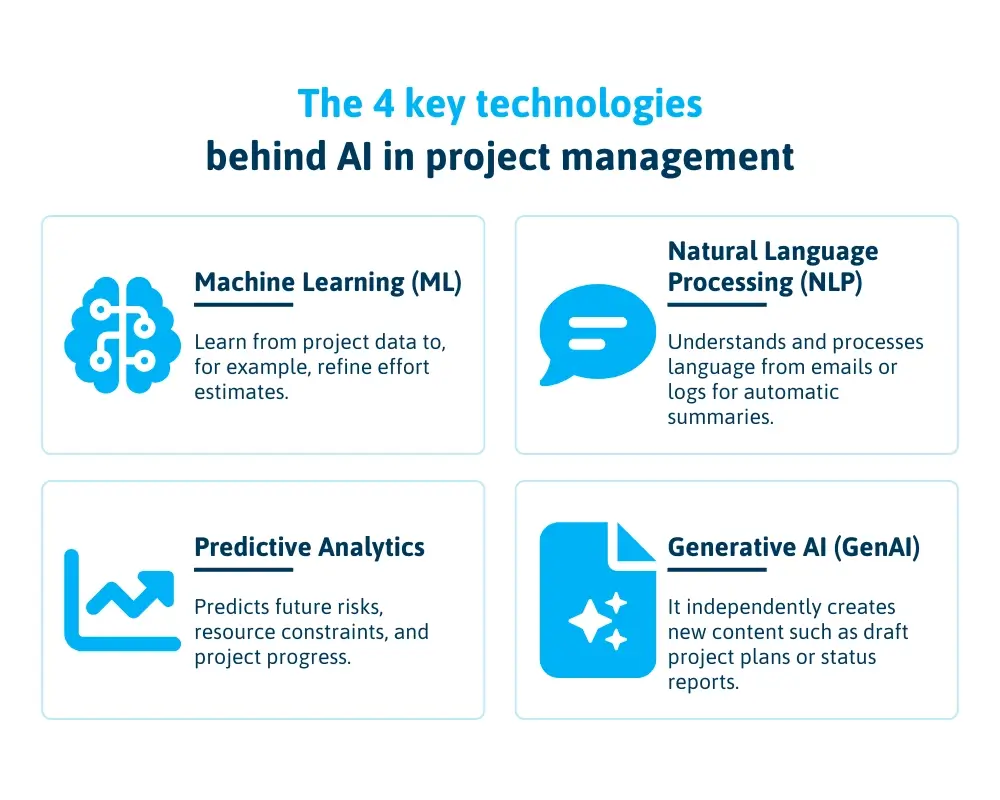
- Machine learning (ML): Learns patterns and regularities from historical project data in order to make effort estimates more precise and realistic, for example.
- Natural Language Processing (NLP): Understands and processes human language from texts, protocols, and emails, for example, for automatic summaries or the analysis of stakeholder feedback.
- Predictive analytics: Uses historical and current data to predict future risks, resource bottlenecks, and likely project outcomes.
- Generative AI (GenAI): Independently creates new content such as draft project plans, status reports for management, or even code snippets for development teams.
How does AI specifically support project management?
AI is no longer a thing of the future, but a tried-and-tested tool that is already making life much easier for project teams. An Adecco study from 2024 shows that German employees gain an average of 113 minutes per day through the use of AI – double the amount compared to the previous year. Although the study was conducted across multiple industries, project management is a particularly clear example of how this gained time can be used for strategic planning, stakeholder communication, and team leadership.
Which projects are best suited for AI?
Not every project benefits equally from AI automation. A tried-and-tested model by Barth and Saarstedt helps to classify projects:
- Standard projects: With clear, recurring requirements and low complexity. Here, AI can take over a large part of the planning and control autonomously.
- Acceptance projects: Technologically simple, but with high social complexity (e.g., change projects). Here, AI primarily supports communication and the analysis of stakeholder feedback.
- Potential projects: Technologically demanding, but with low social hurdles (e.g., R&D projects). Here, AI is a powerful tool for simulations, forecasts, and the optimization of plans.
- Pioneering projects: As in other types of projects, AI acts as a supporting tool in pioneering projects – the final decision-making and control responsibility remains with the project manager.
This framework helps to decide where AI should be used as an autonomous agent and where it should be used purely as an assistance system.
How does AI optimize project planning and resource allocation?
Manual project and resource planning is often characterized by subjective estimates and an unconscious optimism bias. Resource conflicts in multi-project environments usually only become apparent when it is already too late. This is where AI systems based on machine learning come in. They analyze historical project data such as past expenses, the actual performance rate of individual employees, and even seasonal failure rates. From this, they learn patterns – for example, that certain project phases systematically run over time or that junior developers need 30% more time than seniors for specific tasks.
When planning new projects, AI uses this information to suggest realistic schedules and proactively warn of impending bottlenecks. However, in order for AI to make valid suggestions, it needs a structured, valid database. With PLANTA Project, you can create exactly this “single source of truth.” The software centralizes all resources and projects so that analyses are based on facts, not assumptions in scattered Excel lists. The result is unprecedented transparency across the entire project portfolio.
How is AI revolutionizing risk management?
In traditional project management, risks are often dealt with reactively – putting out fires instead of preventing them. Of course, tools such as PLANTA Project have long offered advanced control and monitoring features, such as earned value analysis or trend analysis, which indicate deviations from time and budget at an early stage.
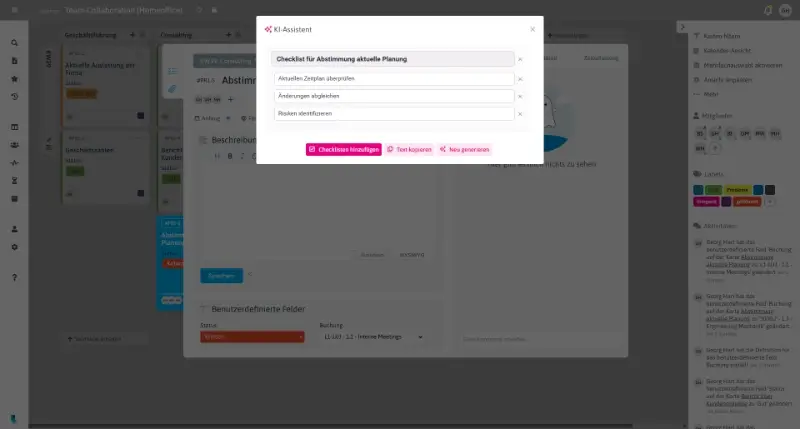
However, AI complements these proven tools with proactive and generative capabilities. In PLANTA Project, AI support already helps with identifying risks and opportunities, generating schedules and checklists, and acting as a writing assistant for project descriptions. For example, if 40% of the budget has already been used up after three weeks of a twelve-week project, AI not only predicts the likely budget overrun. It also identifies dependency risks and can proactively suggest reprioritizing tasks to minimize delays. Instead of a reactive “red” traffic light system that only indicates an emergency, AI enables proactive “yellow” signals. This gives teams valuable time to take countermeasures before a situation becomes critical.
What role do AI assistants play in communication?
Every project manager knows that after a 90-minute meeting, it takes another 45 minutes to write up the minutes and to-do lists—valuable time that is lost every day. AI-powered assistants and chatbots automate this routine communication. Automated logging tools participate in meetings, transcribe what is said, recognize speakers, and automatically extract decisions, risks, and tasks, which they assign directly to the responsible persons. This turns 45 minutes of follow-up work into a 5-minute check.
- Automated logging of meetings, including assignment of action items.
- Creation of status reports at the touch of a button, pulling relevant KPIs from the system.
- Translation of project documents to facilitate collaboration in international teams.
Why is data the gold of the AI era?
The old IT principle “Garbage In, Garbage Out” applies to artificial intelligence more than ever. An AI system is only as intelligent as the data it is trained on. According to an IBM study, data scientists spend 80% of their time cleaning data and only 20% on actual analysis. For project management, this means: if historical project data is scattered across countless Excel spreadsheets, emails, and isolated solutions, no algorithm in the world can generate reliable forecasts. It will either “hallucinate” and invent facts or deliver statistically biased predictions.
Data silos and a lack of standards are the death of any effective AI strategy. The mandatory prerequisite for the successful use of AI is therefore a professional project management software that acts as a central nervous system. It creates a “single source of truth” by enforcing data standards, preventing duplicates, and synchronizing information in real time. Only on such a clean, structured, and centralized data foundation can AI models fully realize their potential and deliver precise, trustworthy results.
How do you ensure security and data protection (GDPR)?
The fear of data leaks is particularly strong in sensitive industries such as pharmaceuticals and mechanical engineering. The question “Are we allowed to upload our project data to public AI tools?” is absolutely justified. The answer is: no, at least not without restrictions. Security and data protection are non-negotiable for PLANTA as a German manufacturer. When using any AI, please always ensure that you comply with data protection regulations.
The decisive advantage of on-premises or private cloud solutions, such as those offered by PLANTA Project, is obvious: your sensitive project data remains fully under your control within your own IT infrastructure or in a dedicated German data center. In contrast to open US cloud tools, where data leakage poses a real risk, we ensure that your data sovereignty is preserved. This is not paranoia, but a decisive competitive advantage and an absolute necessity for compliance and the protection of intellectual property.
What role will the project manager play in the future?
The frequently asked question “Will my job be replaced by AI?” can be answered clearly: the role of the project manager will not be eliminated, but transformed and elevated. The administrative “bookkeeping” part of the job – tracking numbers, creating manual reports, updating schedules – will increasingly be taken over by AI.

This newly freed time is invested in the tasks that create the true value of a project manager and cannot be taken over by any machine: stakeholder management, conflict resolution, team leadership, and strategic decision-making. The role shifts from administrator to project strategist—someone who interprets the recommendations provided by AI, makes human decisions, and above all leads people. This is not a devaluation, but a significant enhancement of the role.
What are the 3 Cs for an AI-ready project manager?
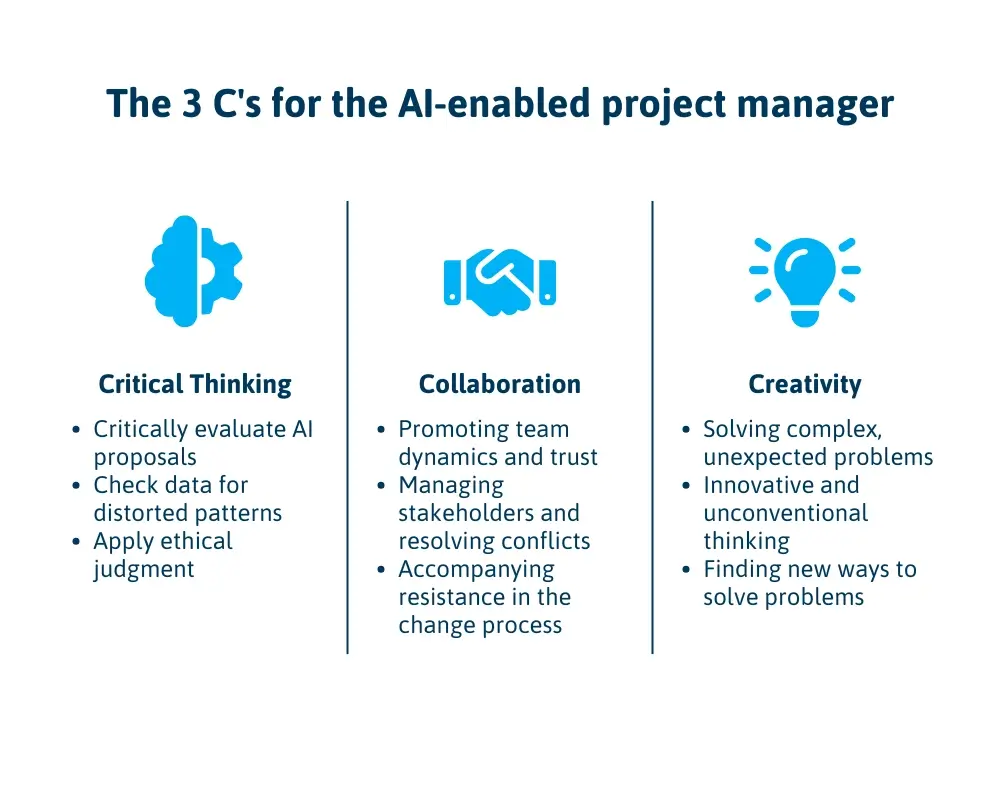
To succeed in the AI era, skills that machines cannot master come to the fore. The well-known 4C model of “21st Century Skills” (Critical Thinking, Communication, Collaboration, Creativity) can be distilled for project management into three core competencies:
-
Critical Thinking: AI delivers suggestions, forecasts, and data analyses. Humans must critically assess them: Is this risk forecast plausible? Is the analysis based on representative data or on biased patterns? This requires skepticism, data literacy, and ethical judgment.
-
Collaboration: While AI automates routines, team dynamics, trust-building, and conflict resolution remain purely human domains. The project manager of the future is an excellent communicator who brings stakeholders together, manages resistance in change processes, and ensures a motivated team.
-
Creativity: Complex, unexpected problems—such as a sudden disruption in the supply chain or a technical risk with political implications—require innovative and unconventional thinking. This creative problem-solving will remain a human domain for the foreseeable future.
Conclusion on AI in project management
Artificial intelligence in project management is a powerful accelerator for efficiency, precise planning, and the early identification of risks. It automates routine tasks and provides data-driven foundations for decision-making. Nevertheless, humans remain indispensable as strategic decision-makers and empathetic leaders (“human in the loop”). The absolutely critical prerequisite for any AI success is clean, centralized, and secure data management. Companies that start now to professionalize their data structure with professional PM software like PLANTA will be the winners of the AI transformation. They will not only achieve a significant productivity boost, but also attract the best talent—people who want to work with modern tools, not Excel chaos.
Frequently Asked Questions about AI in Project Management
What AI tools are available for project management?
The market offers a wide range of AI tools for project management. These range from specialized standalone solutions for automated meeting minutes to GenAI tools for text creation. However, the future-proof approach lies in integrated solutions. Modern enterprise software such as PLANTA integrates intelligent functions—such as AI support for generating schedules, identifying risks and opportunities, and text creation—directly into the core system. This avoids data silos and creates a consistent, reliable data foundation.
Will AI replace project managers?
No, but AI will radically change the role of the project manager. It will shift from an administrator who maintains data to a strategic manager and leader who interprets data. AI takes over routine tasks and complex analyses, while empathy, leadership skills, negotiation abilities, and ethical decision-making remain essential human capabilities that are enhanced—but not replaced—by technology.
How secure is my project data when using AI?
The security of your data depends heavily on the tool you use. Public AI models require caution, as inputs may be used to train the model. Secure use requires closed systems or “Made in Germany” software such as PLANTA, which strictly complies with the highest data protection standards (GDPR) and offers on-premises or private cloud options. Sensitive project data should never be entered unprotected into public AI services.
How do I get started with AI in project management?
The best way to start is in small, controlled steps. The first and most important step is to consolidate your data foundation—moving away from Excel lists toward a central PM software. Then analyze your processes to identify where the most time is wasted on administrative tasks. Next, launch a pilot project, such as a small event or an internal software rollout, and use features like automated status reports to gain experience and build trust within the team.
What are the biggest risks of AI in project management?
The biggest risks are “hallucinations,” where the AI invents facts, and so-called “bias,” where biased training data leads to distorted results. Additional risks include insufficient data security and copyright issues when using GenAI. Another central risk is the loss of expertise if project managers rely blindly on algorithms instead of using them as tools to support decision-making.