Time Management in Project Management: Methods, Mistakes and Control in a Multi-Project Environment
| Translated by Julian Hammer

Time is one of the scarcest resources in project management – and at the same time one of the most frequently underestimated. Project plans are carefully created, milestones defined and deadlines aligned. Nevertheless, projects stall, are postponed or fall behind the original schedule. Not because too little planning was done, but because time management in everyday project work often functions differently than it does on paper.
Effective time management is one of the fundamental pillars of successful project management. It influences how realistically projects can be planned, how effectively teams collaborate and how reliably deadlines are met. In practice, however, time planning and control are among the greatest challenges: priorities change at short notice, dependencies are underestimated and resources are not always available to the extent originally planned.
To ensure that projects still progress in a structured manner, more is required than a well-filled project plan. Clear methods, transparent processes and continuous control of timelines are essential – particularly in multi-project management, where time and resources must be coordinated across several initiatives and project transparency at management level becomes a decisive success factor.
What Does Time Management Mean in Project Management?
Time management in project management includes all activities required to structure project tasks over time, define realistic deadlines and continuously monitor progress.
The objective is to ensure that a project can be completed within the planned timeframe without jeopardizing quality or other project goals. It is not about maximum speed, but about reliable planning and control under real conditions.
The focus is not solely on scheduling, but on the interaction of various elements: a clearly defined scope, a transparent structuring of work, realistic effort estimations and transparent monitoring of project progress. Only when these factors are aligned can schedules be created that remain stable throughout the course of the project.
Time management therefore connects operational planning with strategic decision-making. It helps to identify dependencies, make bottlenecks visible at an early stage and set priorities in a way that enables teams to work efficiently and in a goal-oriented manner. Especially in projects with multiple stakeholders, limited resources or parallel initiatives, it becomes clear that time management performs a central control function. This applies equally to traditional, agile and hybrid project environments – each with different focal points, but with the same objective: to make optimal use of the available timeframe so that projects not only start on time, but also reach completion in a predictable and structured manner.
6 Typical Time Management Mistakes in Multi-Project Management
Despite careful planning, similar challenges repeatedly occur in projects, leading to delays or unnecessary additional effort. The following typical mistakes highlight where time management reaches its limits and where there is potential for optimization.
1. Unrealistic Effort Estimates
A frequent cause of schedule delays is overly optimistic effort estimation. Experience values are often not sufficiently considered, or buffers are set too low, resulting in ambitious deadlines that are difficult to meet later on. Even minor deviations can therefore lead to schedule shifts that can hardly be compensated for in the further course of the project.
2. Lack of Task Prioritization
Without clear priorities, teams quickly lose focus. Tasks with high urgency are handled in parallel with less important activities or are constantly interrupted. Critical work packages are delayed while resources remain tied up elsewhere where they are urgently needed. In such situations, time management loses its controlling effect.
3. Insufficient Monitoring of Project Progress
Even good planning is only effective if progress is regularly reviewed. Without systematic monitoring, deviations remain undetected for a long time. Decisions are then based on outdated assumptions, meaning that necessary corrections are implemented too late and schedule problems continue to escalate.
4. Resources as a Bottleneck Factor in Multi-Project Management
Time planning is closely linked to resource planning, especially when managing multiple projects simultaneously. If capacities are considered in isolation per project or allocated multiple times, bottlenecks arise: double bookings, overload and missing expertise at critical moments. These lead to waiting times, prioritization conflicts and delays that, particularly in multi-project environments, quickly affect several initiatives at the same time. Time management can only function effectively if resource planning is treated as an integrated component – not as a separate process.
5. Frequent Rescheduling Without a Clear Structure
Projects are subject to change. However, if rescheduling takes place without defined processes, clear decision rules or transparent communication, commitment is lost. Schedules are constantly adjusted without achieving long-term stability. The additional coordination effort consumes capacity and reduces the efficiency of project work.
6. Unclear Communication and Coordination
Delays also occur when information is provided too late or incompletely. Missing feedback, unclear responsibilities or unstructured meetings can significantly disrupt timelines. Decisions are postponed, follow-up questions increase and the project schedule stalls.
What is Scope Creep?
Scope creep refers to the gradual expansion of a project’s scope during the course of a project without these changes being systematically evaluated or formally approved. New requirements, additional features or detailed adjustments are added, even though objectives, timelines and resources were originally defined differently. This often happens gradually and remains unnoticed for a long time.
The effects usually become visible with a delay. Additional content increases workload, extends processing times and creates new dependencies between tasks. The existing schedule comes under pressure without the causes being immediately apparent. Deadlines are postponed, priorities change at short notice and the coordination effort within the project increases significantly.
Scope creep is closely linked to many of the previously mentioned time management mistakes. Unrealistic effort estimates are intensified because additional work has not been planned. A lack of prioritization becomes more severe when new tasks are added without structure. Resource bottlenecks occur more frequently because capacities are already committed. Without consistent monitoring and clear communication structures, the growing workload remains unnoticed for a long time.
Under these conditions, time management loses its controlling function. Only through clear rules for handling changes and a transparent evaluation of their impact can schedules remain stable and projects be managed reliably.
Time Management Methods
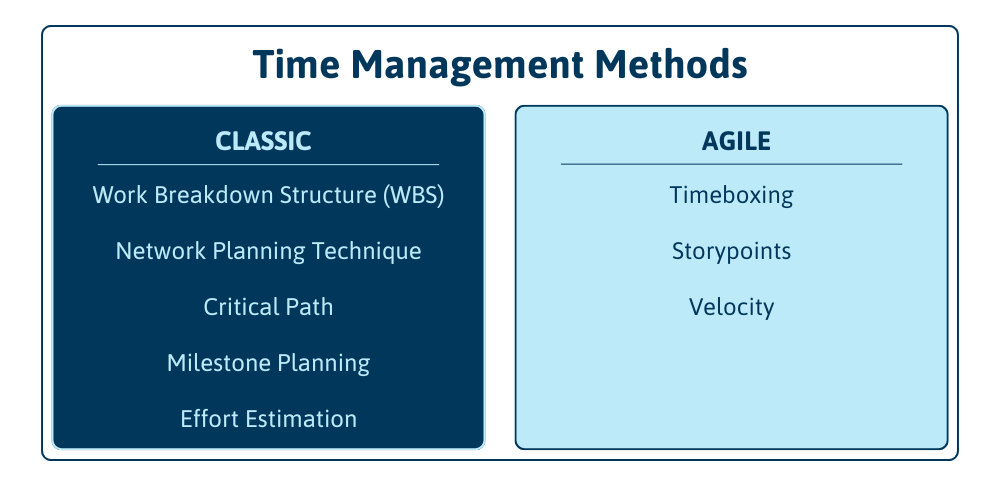
Various methods have been established to effectively manage time in everyday project work. They support project managers in planning tasks realistically, setting priorities and reliably meeting deadlines. Depending on the type and scope of the project, its complexity and environment, different approaches are applied – ranging from traditional planning techniques to agile time management methods.
Work Breakdown Structure (WBS)
The Work Breakdown Structure forms the foundation for any time planning. It divides the project into manageable work packages that can be planned and controlled individually. Through its hierarchical structure, the overall scope becomes tangible and can be gradually transformed into schedulable units. The WBS therefore creates the basis for realistic time estimates and transparent scheduling.
What the WBS provides:
- Hierarchical representation of the project scope
- Visibility of all deliverables required to achieve the project result
- Foundation for estimations, scheduling and resource planning
Based on the WBS, work packages can then be described in detail, including information such as responsibilities, estimated effort, risks or required resources. Only with this additional information does realistic scheduling and capacity planning become possible – the WBS provides the structural foundation for this.
Network Planning Technique
The network planning technique visualizes dependencies between tasks and makes time-related relationships transparent. While the Work Breakdown Structure defines what needs to be done in the project, the network planning technique shows in which sequence tasks must be carried out and how they depend on each other over time. It illustrates which activities can run in parallel and which must build on one another. This makes it possible to identify critical paths and recognize time buffers.
The focus lies on activities and their dependencies. Tasks are not viewed in isolation but in relation to one another. This makes it visible which work steps can only begin after others have been completed and where time flexibility exists. This transparency is essential for creating realistic schedules and identifying risks at an early stage.
A key result of the network planning technique is the identification of time-critical activities. Delays in these areas have a direct impact on subsequent tasks and on the overall project deadline. At the same time, buffer times become visible and can be used when necessary without jeopardizing the final deadline.
For time management, the network planning technique offers several advantages:
- Dependencies between tasks are clearly and transparently illustrated
- Critical activities and time bottlenecks can be identified at an early stage
- The impact of delays becomes transparent
- Adjustments during the project can be evaluated in a targeted manner
The network planning technique therefore supports forward-looking scheduling. It helps project managers not only keep track of individual deadlines but also control the overall time structure of the project. Especially in complex projects with numerous dependencies, it is a key instrument for robust time management.
Milestone Planning
Milestones mark important interim objectives in the course of a project. They serve as reference points and make it possible to assess progress in a structured and transparent way. By defining milestones, the project is divided into manageable phases, which facilitates time control.
In contrast to detailed schedules, milestone planning focuses on key points within the project timeline. It shows when significant results must be achieved and which phases or work packages contribute to them. This level of consolidation simplifies communication and creates a shared time perspective for all stakeholders.
Milestones create commitment and transparency. They indicate when specific results must be available and enable early verification of whether the project is on schedule. Especially in longer projects, milestones help maintain an overview and allow timely corrective action if deviations occur.
Milestone planning is particularly suitable for the overarching control of projects and project phases. In combination with detailed methods such as network planning or the critical path, it ensures that time management is not only effective at the operational level but also remains impactful at a strategic overview level.
Effort Estimation
The quality of a schedule depends largely on the accuracy of the estimates. Various methods are used to ensure reliable planning:
- Top-Down Estimation
In top-down estimation, the overall effort is determined based on a higher-level project objective and then broken down into individual subareas. Experience from comparable projects or specifications provided by clients and management serve as the starting point. This method offers a quick overview of the total effort and is particularly suitable in early project phases when only limited detailed information is available.
One advantage of top-down estimation is its speed and clarity. A disadvantage is that early assumptions are not always precise if the project scope is still unclear or highly variable.
- Bottom-Up Estimation
In contrast to the top-down approach, bottom-up estimation calculates effort at the level of individual work packages or tasks and then aggregates the results. This method is based on a detailed breakdown of the project, for example using the Work Breakdown Structure.
Bottom-up estimation generally delivers more accurate results than top-down estimation because it is based on detailed analysis of individual tasks. It is particularly useful when substantial information about the work packages is already available. However, it requires more time and effort during the planning phase.
- Additional Methods
| Method | Short Description | Typical Use | Strengths | Limitations |
|---|---|---|---|---|
| Delphi Method | Several experts independently estimate the effort. The results are compiled anonymously and iteratively adjusted until a consensus is reached. | Complex or novel projects with high uncertainty | Reduces individual bias, leverages collective experience | Time-consuming, dependent on the availability of suitable experts |
| Analogy Method | Effort is derived from a similar, previously completed project and adjusted for differences. | Projects with comparable initiatives in the past | Quick to apply, practice-oriented | Reliable only if projects are truly comparable |
| Multiplication Method | Effort is calculated using fixed factors or metrics, for example effort per function, module or unit. | Standardized projects or recurring tasks | Easy to apply, highly scalable | Simplified approach, individual specifics are barely considered |
| Ratio Method | The effort of individual tasks is assessed in relation to one another, for example in comparison to a reference task. | Early planning phases or rough estimations | Supports relative assessments, requires little detailed knowledge | Does not provide exact time figures, mainly indicative |
| Weighting Method | Tasks are weighted based on defined criteria such as complexity, risk or scope, and total effort is derived accordingly. | Projects with many tasks of varying complexity | Differentiated evaluation, transparent assumptions | Requires clear criteria and experience in weighting |
Agile Time Management Methods
Agile methods rely on shorter planning cycles, continuous adaptation and empirical data. They are particularly suitable for projects with a high degree of uncertainty or changing requirements. In this context, time management is not planned in full in advance, but refined step by step.
The objective is to respond to changes without losing sight of the overall timeframe.
Timeboxing
Timeboxing is one of the core methods for time management in agile projects. The basic idea is not to let work run indefinitely, but to deliberately place it within fixed time frames. A timebox can be a sprint, a workshop, an analysis phase or even a single meeting. The duration is defined from the outset and is not extended due to additional requirements.
For time management, timeboxing offers a clear advantage: it creates commitment and protects against excessive detail work. Tasks are completed within a defined framework. If the time is not sufficient, the duration is not automatically extended; instead, the scope is adjusted, reprioritized or postponed to a later cycle. This keeps the timeframe stable, which significantly facilitates planning, coordination and expectation management.
Timeboxing also supports realistic control during the course of the project. Teams receive regular planning and feedback points where progress is assessed and next steps are decided. This reduces the risk that deviations only become visible at a late stage.
Story Points
Story Points are a method of relative effort estimation in agile projects. Instead of evaluating tasks in hours or days, teams estimate effort in relation to one another. Factors such as complexity, uncertainty and scope are taken into account in the assessment.
For time management, the advantage of Story Points lies in their ability to handle uncertainty better than traditional time estimates. Precise time specifications often suggest a level of accuracy that is unrealistic in everyday project work. Relative estimates reduce this effect and provide a more reliable basis for planning.
Story Points support time control particularly in combination with fixed timeframes. When used together with timeboxing, it becomes possible to determine how much work a team can typically complete within a defined time period. Based on this, future planning becomes more realistic and transparent.
Another benefit lies in the collaborative estimation process within the team. Different perspectives are considered, assumptions are made transparent and risks become visible at an early stage. This not only improves the quality of the estimate but also strengthens commitment to the planned objectives.
Story Points therefore contribute to making time planning in agile project environments more robust and adaptable. They do not replace scheduling, but provide a realistic foundation for managing time effectively under uncertain conditions.
Velocity
Velocity describes the amount of work a team actually completes within a fixed period of time. It is typically measured based on Story Points and observed across several iterations. This creates a realistic picture of how much output a team can deliver under given conditions.
For time management, velocity is a key control instrument. It replaces assumptions with empirical data and enables reliable forecasting for future planning. Instead of working with theoretical capacities, planning is based on actual results achieved. This allows time expectations to be aligned more closely with reality.
Velocity also helps to identify overload at an early stage. If the planned workload consistently exceeds the average velocity, it becomes clear that deadlines or scope need to be adjusted. Time management thus becomes both proactive and responsive.
Another advantage lies in continuous improvement. Changes in team composition, working methods or framework conditions are directly reflected in the velocity. Planning can be adapted accordingly without fundamentally redesigning existing time models.
Velocity therefore makes a significant contribution to realistic time control in agile projects. In combination with timeboxing and Story Points, it provides a solid foundation for planning deadlines in a transparent and reliable manner rather than relying on assumptions.
Learn more about agile project management methods and the differences compared to traditional project management.
How Project Management Software supports Time Management
Without systematic support, time management in project management quickly reaches its limits. The more complex projects become and the more initiatives must be managed in parallel, the more difficult it is to keep track of deadlines, dependencies and resources using purely manual methods or isolated tools. Project management software creates the necessary transparency and integrates planning, control and monitoring within a consistent system.
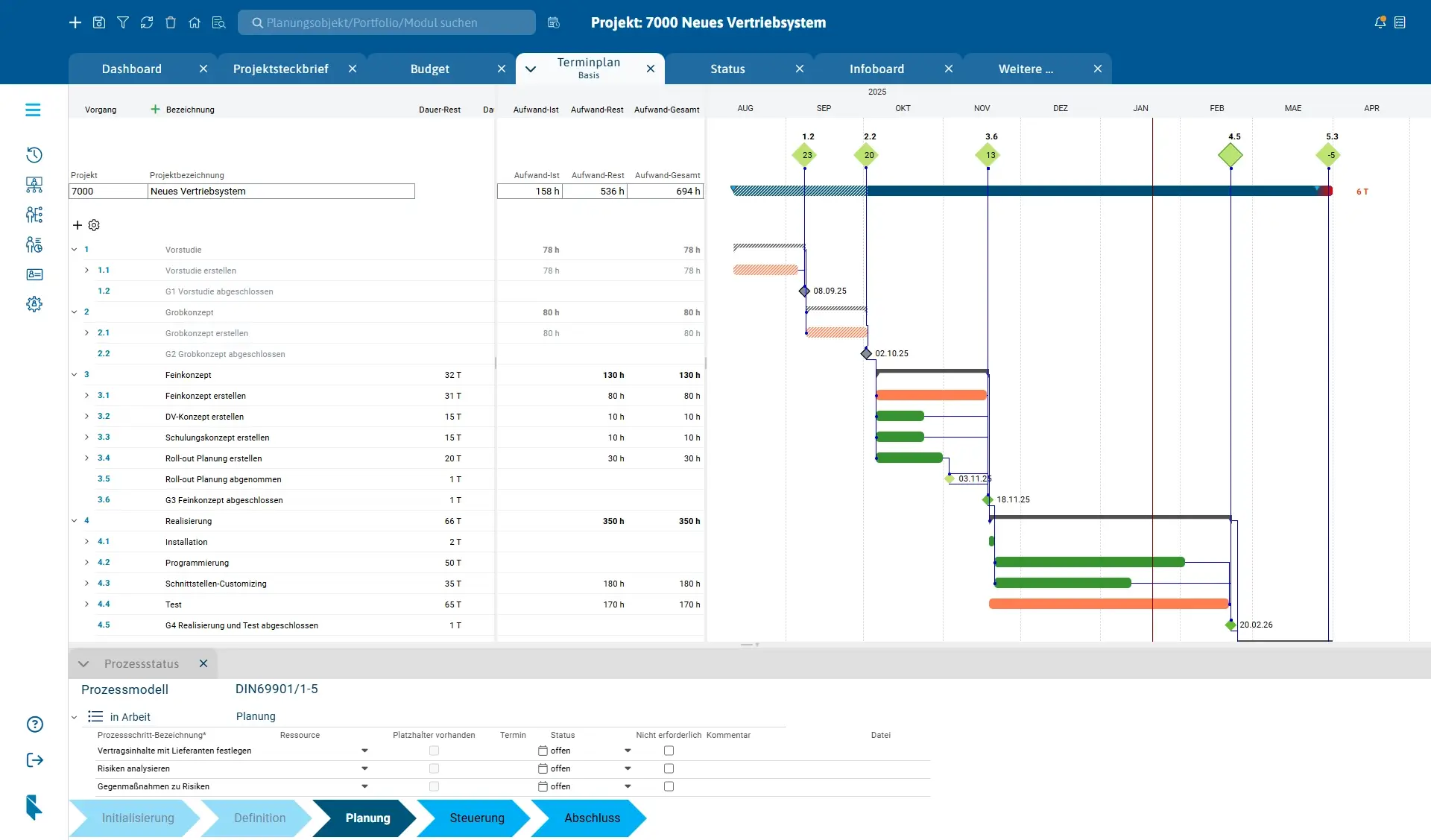
Modern PM software primarily supports time management by centrally consolidating time-related information. Project plans, deadlines, dependencies, progress and resource availability are consistently interconnected. Changes made in one area have a transparent impact on the overall schedule. This allows schedule risks to be identified early and managed in a targeted manner.
Another advantage lies in the continuous updating of the plan. Progress can be recorded regularly and compared with the original plan. Deviations become visible before they become critical. Time management thus becomes an active control process rather than a one-time planning task at the beginning of the project.
PM software plays a particularly central role in multi-project environments. It enables priorities to be managed across projects, resource conflicts to be identified and scheduling decisions to be made on a reliable data basis. Time is not viewed in isolation per project, but managed within the overall context of the organization.
PLANTA Project supports time management precisely at these critical points. The objective is to make projects predictable and to manage deadlines reliably, even under real-world conditions.
PLANTA combines structured project planning with transparent schedule control. Work Breakdown Structures, dependencies and milestones are directly interconnected and form the basis for realistic schedules. Changes in project scope or workflow are clearly represented and can be evaluated in a targeted manner.
A key advantage lies in the integrated resource and capacity planning. Schedules are not created in isolation but always considered in relation to available capacities. Bottlenecks can be identified at an early stage, priorities can be adjusted and deadlines can be realistically reassessed.
Through continuous project controlling, progress is transparently recorded and compared with the plan. Deviations over time become visible and enable timely control measures. Time management thus becomes a dynamic process that continuously connects planning with reality.
Time Management in Hybrid Project Control
Hybrid project environments combine traditional and agile approaches within a single project or across multiple projects. While certain project phases or subareas are planned long-term and fixed in terms of deadlines, other areas are managed iteratively and flexibly. For time management, this represents a particular challenge, as different planning logics must be considered simultaneously.
In hybrid project management, it is not sufficient to manage time solely through rigid schedules or purely through iterative cycles. Traditional elements such as milestones, dependencies and fixed end dates remain relevant, especially for coordination, reporting and external requirements. At the same time, agile working methods require short planning intervals, regular adjustments and a stronger focus on actual progress.
Effective time management in a hybrid project environment results from the deliberate combination of both approaches. Long-term target dates and milestones provide orientation and stability. Iterative planning ensures that changes can be addressed flexibly within this framework. Time is therefore managed both strategically and operationally.
Transparency plays a central role in this context. Project stakeholders must be able at all times to understand how short-term adjustments affect higher-level deadlines. Dependencies between traditionally planned and agile-managed tasks must be visible in order to identify schedule risks at an early stage. Without this transparency, inconsistencies between planning and execution quickly arise.
Hybrid time management does not aim to reduce complexity, but to make it manageable. By combining long-term planning, short-term control and transparent oversight, deadlines can be reliably met even in dynamic project environments.
Conclusion
Time management in project management is driven by clarity, realism and consistent control. What matters is not perfect planning, but the ability to keep schedules stable under real conditions and adjust them in a targeted manner when necessary.
Methods and software provide the necessary structures for this. They create transparency, make dependencies visible and enable well-founded decisions. Especially in multi-project management and hybrid project control, it becomes clear that reliable time management can only succeed when planning and execution are continuously connected.
Project management software such as PLANTA Project supports this approach by not viewing time in isolation, but as part of an integrated project control system. This ensures that time management remains feasible even as complexity increases.