AI in Risk Management: How AI Identifies Project Risks and Where Humans Make the Decisions
AI-powered risk analysis is an approach in which artificial intelligence uses the project information already recorded to suggest possible risks, opportunities, and measures. Assessment, decision-making, and follow-up remain with the project team. AI therefore does not replace risk analysis, it shortens the start: Instead of beginning with an empty risk register, the team starts with a first draft.
The need for this arises at the same point in almost every project. Risks are collected in a workshop at project start, often under time pressure and dependent on the experience of just a few participants. Opportunities are frequently overlooked, and measures lack named owners. The risk register then documents, but it does not steer.
This is about AI as a tool in the project, not about risk management for AI systems themselves, as required by the EU AI Act, for example. This article shows how AI-powered risk analysis works, what project information it needs, where its limits lie, and what the process looks like in project management software. For a general overview of technologies, fields of application, and the role of the project manager, see our introductory article on AI in project management.
In short: AI suggests, the project team assesses and decides. The quality of the suggestions depends directly on the quality of the project description.
Table of Contents
- What Is AI-Powered Risk Analysis in a Project?
- Why Do Risk Registers Remain Incomplete in Many Projects?
- How Does AI-Powered Risk Analysis Work?
- What Are the Benefits of AI in Risk Management and Where Are Its Limits?
- What Role Does the PMO Play in AI-Powered Risk Management?
- What Does AI-Powered Risk Management Look Like in Practice?
- Conclusion on AI in Risk Management
- Frequently Asked Questions About AI in Risk Management
What Is AI-Powered Risk Analysis in a Project?
AI-powered risk analysis is the identification of project risks, opportunities, and measures in which AI generates the first draft from existing project information. The goal remains the same as in conventional risk analysis: to identify uncertainties early, assess them, and make them manageable. The only thing that changes is who takes the first step.
To make the following sections easier to follow, here is a brief look at the key terms:
- Risk: a possible event that has a negative impact on the schedule, costs, quality, or scope of the project.
- Opportunity: a possible event with a positive impact, such as a component becoming available earlier or a source of funding.
- Measure: a planned action that reduces a risk or makes an opportunity usable.
- Probability of occurrence and impact: the two axes along which a risk is assessed.
- Risk matrix: the graphical representation of all risks by probability of occurrence and impact.
- Risk register: the central list of all risks, opportunities, and measures in a project.
The difference between conventional and AI-powered risk analysis lies in the starting point, not in the responsibility:
| Characteristic | Conventional risk analysis | AI-powered risk analysis |
|---|---|---|
| Starting point | Empty risk register | Draft based on project information |
| Source of knowledge | Experience of the workshop participants | Project description plus the team’s experience |
| Opportunities | Often forgotten | Systematically suggested as well |
| Assessment | Project team | Project team |
| Decision and responsibility | Project manager | Project manager |
The table shows the core point: AI changes how quickly a complete picture emerges. It does not change who is accountable for it.
For an overview of conventional risk analysis methods such as FMEA, pre-mortem, or Monte Carlo simulation, see our article Risk Management Methods in Project Management.
Why Do Risk Registers Remain Incomplete in Many Projects?
Risk registers remain incomplete because, in many organizations, capturing risks is a one-time meeting rather than part of ongoing project control. Four causes regularly occur together:
- Risk identification as a one-time event: Risks are collected at the kick-off or shortly afterwards. After that, the register is rarely updated, even though scope, stakeholders, and general conditions change.
- Knowledge in just a few heads: Which risks are named depends on who is in the workshop. Experience from previous projects is only included if the person in question is present and remembers it.
- Opportunities fall by the wayside: Attention is focused on threats. Positive uncertainties are hardly recorded and therefore not deliberately exploited.
- Measures without owners: A measure without a named person and without a deadline is merely a statement of intent. It does not appear in any task list and therefore does not get done.
The result is a register that exists on paper but has no steering effect. Risks only become visible once they have occurred. At that point, they are no longer risks but problems.
On top of this, there is time pressure in the initiation phase. Anyone preparing the project charter, schedule, and resource requests at the same time often treats risk analysis as a mandatory exercise. This is exactly the bottleneck that AI support addresses: It reduces the effort required for the first complete draft and thus frees up time for the actual assessment.
How Does AI-Powered Risk Analysis Work?
AI-powered risk analysis follows five steps: AI handles the initial collection, and the project team handles assessment, decision-making, and follow-up. Instead of beginning with an empty risk register, the team starts with a first draft.
- Capture project information: The goal, scope, general conditions, and stakeholders are described in the project core data. This description is the basis on which the AI works.
- Generate AI suggestions: From the project description, the AI derives possible risks, opportunities, and suitable measures. The result is a draft, not an assessment.
- Review and assess: The team removes unsuitable suggestions, adds missing ones, and assesses each entry by probability of occurrence and impact.
- Define measures and owners: Each measure is assigned a responsible person and a deadline. Only then does an entry become a manageable task.
- Follow up over the course of the project: Risks are reassessed at fixed points in time, for example at milestones or in status reports. Comparing the assessment before and after a measure shows whether it is effective.
Step 3 is decisive. The AI only knows what is described in the project. It does not know that a supplier delivered late twice in the last project or that a department is skeptical about the rollout, unless this information is included in the project description.
What Project Information Does the AI Need?
The quality of the suggestions depends directly on the quality of the project description. A brief description leads to generic risks that apply to almost any project. A specific description leads to risks that fit the project. The following information is recommended as a minimum:
- Project goal: What should be measurably achieved at the end?
- Scope and boundaries: What is included, and what is explicitly excluded?
- General conditions: Budget, deadlines, regulatory requirements, technical dependencies.
- Stakeholders: Which departments, service providers, and decision-making bodies are involved?
What this means for you: The time you invest in a careful project description pays off twice: in coordination with stakeholders and in the quality of the risk suggestions.
What Can AI Not Do in Risk Analysis?
AI works with texts and patterns, not with project knowledge in the true sense. This results in three limits that every project team should be aware of:
- No knowledge beyond the data: The AI only knows about informal experience, conflicts between departments, or a supplier’s track record if they are documented.
- No assessment in the organizational context: How critical a risk is for your own company depends on strategy, contractual situation, and risk appetite. This classification remains the responsibility of the project manager.
- Possible incorrect suggestions: Language models can generate entries that sound plausible but are inaccurate. Every suggestion therefore needs a professional review before it is added to the register.
This principle is often referred to as “human in the loop”: The human remains an integral part of every decision, while the AI provides suggestions. Our article AI in Project Management describes the changing role of the project manager in more detail.
How Does the Team Review and Assess the AI Suggestions?
AI suggestions are assessed using the same criteria as manually recorded risks, but they are first checked for suitability. Before a suggestion is added to the risk register, a brief review based on four questions is recommended:
- Does the suggestion apply to this project? Generic risks that apply to any project are removed or made more specific.
- Is the entry a duplicate? Suggestions that rephrase a risk already recorded are merged.
- Is the cause identified? A risk such as “schedule delay” is a consequence. It only becomes manageable through its cause, such as late approval by a department.
- Is the suggested measure appropriate? Measures are checked for effort and effect before they are assigned to a responsible person.
The review is followed by the actual assessment. It is either qualitative, using levels such as low, medium, and high, or monetary, using the expected amount of damage in euros and the probability of occurrence as a percentage. What matters is that everyone involved uses the same scale. Otherwise, risks from different projects cannot be compared.
For follow-up, a comparison over time is useful: A risk trend analysis shows whether the assessment of a risk improves after the measures have been implemented. The assessment methods themselves, such as the risk matrix, heat map, or tornado diagram, are described in detail in our article on risk management methods.
What Are the Benefits of AI in Risk Management and Where Are Its Limits?
The benefit of AI in risk management lies primarily in completeness and speed at the start. Each advantage has a downside that the project team must compensate for with its own work:
| Benefit | Limit | What the project team does |
|---|---|---|
| Fast first draft of the risk register | Some suggestions are generic | Refine for the specific project and remove |
| Opportunities are systematically suggested as well | Not every suggested opportunity is realistic | Assess the benefit and effort of the opportunity |
| Suitable measures are offered directly | Measures do not yet have owners | Define a person and deadline for each measure |
| Less dependence on the knowledge of individuals | AI only knows documented information | Add experience from previous projects |
| Consistent structure across multiple projects | Assessment criteria still need to be agreed upon | Agree on uniform scales for probability and impact |
The table reveals a shift: The team’s work moves from collecting to assessing. This is the real gain, because assessment is the part of risk analysis that requires expertise and judgment.
How much time this actually saves depends on project size, the quality of the project description, and the team’s experience. There are no reliable, generally applicable figures for this.
What Role Does the PMO Play in AI-Powered Risk Management?
The Project Management Office (PMO, the central unit for standards, methods, and project overview in an organization) makes AI-powered risk management comparable across projects. Without common rules, each project team assesses AI suggestions according to its own criteria, and in the end the portfolio shows risks that cannot be compared with one another.
Four decisions typically lie with the PMO:
- Minimum standard for project descriptions: Because the quality of AI suggestions depends on the project description, the PMO defines what information each project must contain at a minimum, for example via project templates.
- Uniform assessment scales: Whether assessment is qualitative or monetary and which levels apply is decided by the PMO in the same way for all projects.
- Rules for AI suggestions: Who reviews suggestions before they are added to the register? Do AI-generated entries remain marked? These questions are clarified once, not anew in every project.
- Securing knowledge across projects: Lessons learned and experience with risks are documented in such a way that they can be incorporated into future project descriptions.
The case study of the pharmaceutical company Siegfried shows how important this foundation is. There, structures that had grown over time and different ways of working led to inconsistent processes, data, and responsibilities. One goal of introducing PLANTA Project was therefore the central documentation of knowledge, risks, and decisions across 13 locations. According to the case study, risks, decisions, and project experience are now documented centrally and available for future projects.
“The introduction of PLANTA Project was more than just an IT project for Siegfried AG; it was a company-wide change process.”
The case study does not refer to the AI function. However, it shows what AI-powered risk management requires: consistent processes and a central memory for risks and experience. Our article What Is a Project Management Office? describes the tasks and structure of a PMO in more detail.
What Does AI-Powered Risk Management Look Like in Practice?
In practice, AI in risk management only delivers its full benefit when suggestion, assessment, measure, and follow-up take place in the same project environment. The following five use cases show the process using PLANTA Project as an example.
1. Have AI Suggest Risks, Opportunities, and Measures
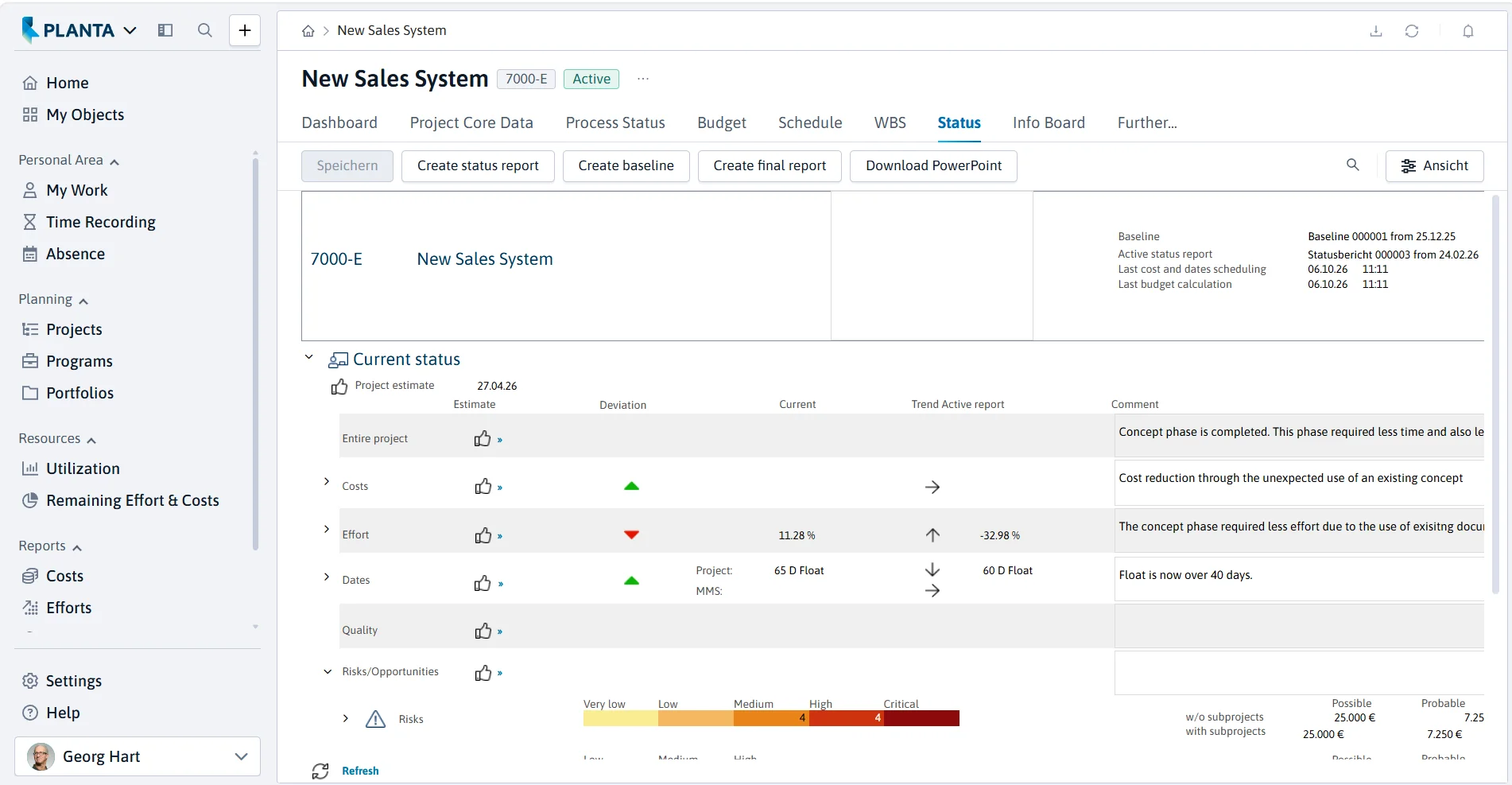
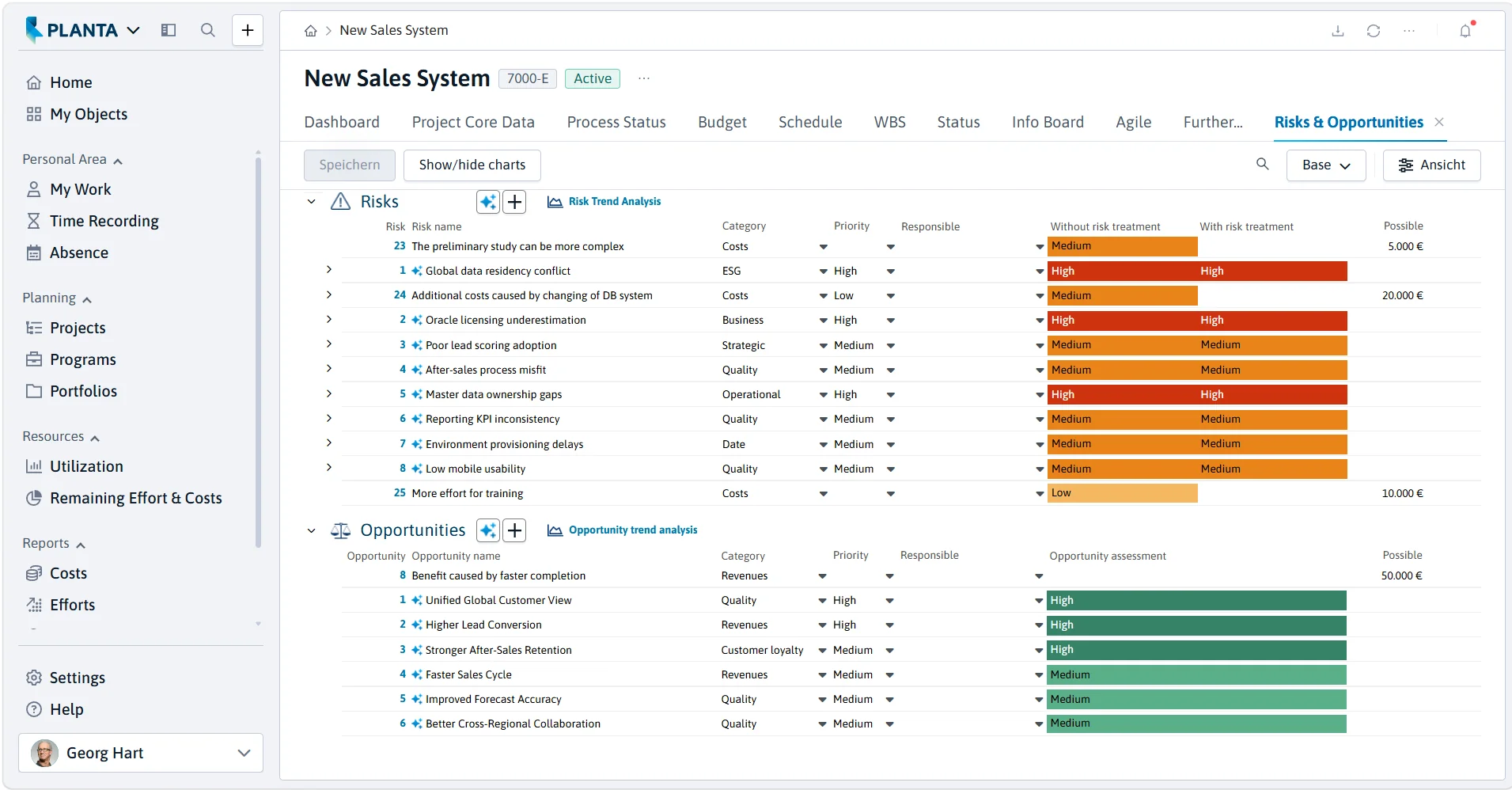
PLANTA Project can use AI to suggest risks, opportunities, and measures for a project. The basis is the project information already recorded, such as key data and the description in the project core data. AI-generated entries are marked with a dedicated symbol, making them clearly distinguishable from manually recorded entries.
What this means for you: The team starts with a draft and focuses on reviewing it instead of starting from scratch.
2. Assess Risks With and Without Risk Treatment
PLANTA Project offers risk management based on ISO 27001. Risks can be recorded, assessed, and tracked both without and with risk treatment. Matrix and chart views with traffic-light fields represent the assessment model. Risks and opportunities can be assessed qualitatively or monetarily, that is, by the amount of damage in euros and the probability of occurrence as a percentage; a risk trend analysis shows how they develop over time.
What this means for you: Whether a measure is effective is shown by comparing the two assessments, not by gut feeling.
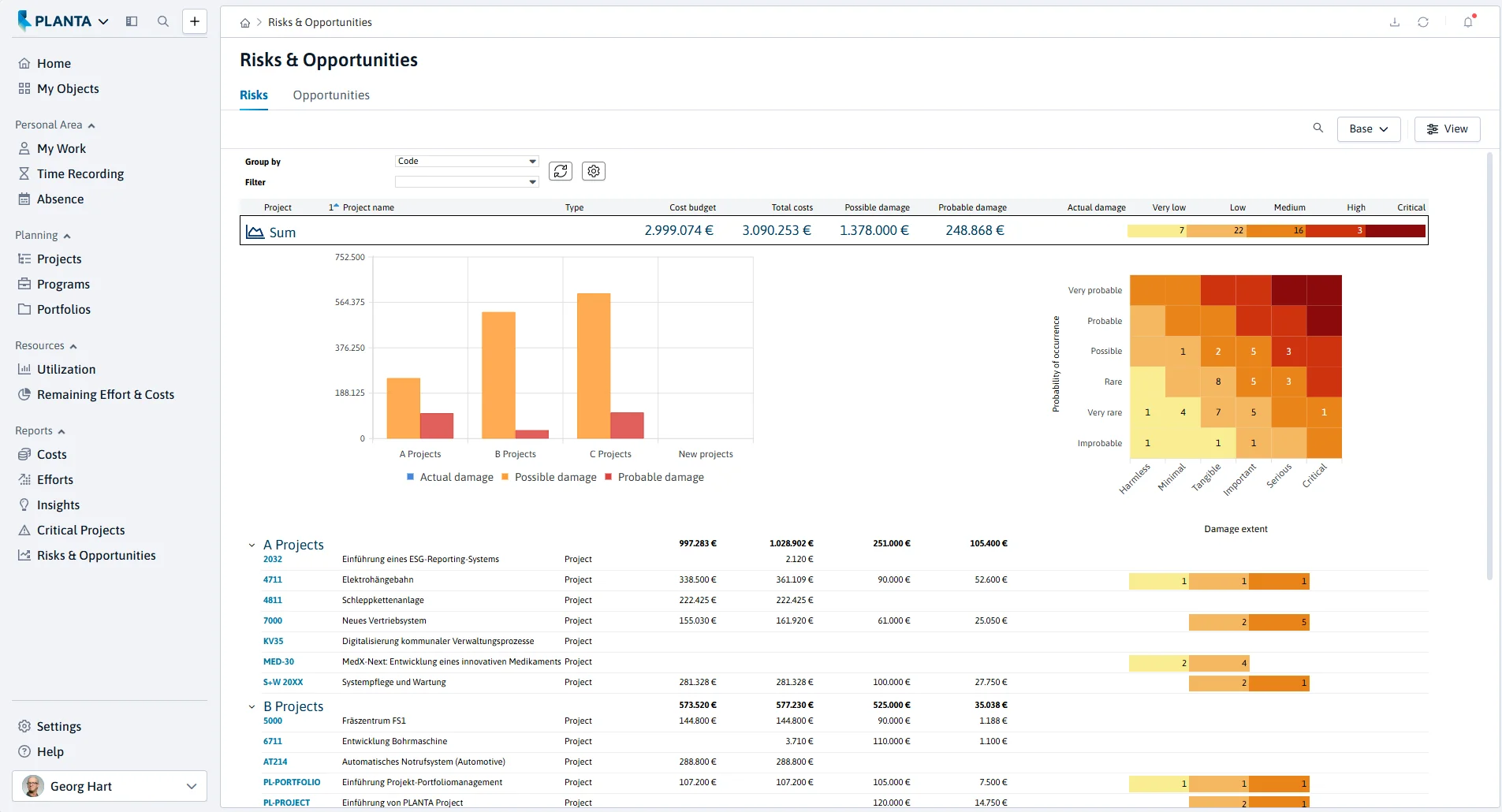
3. Owners See Their Risks and Measures in Their Own Tasks
The persons responsible for risks and measures see these entries directly in their own tasks. In addition, the risk area is displayed consistently at project and portfolio level, so portfolio management uses the same view as the project manager.
What this means for you: A measure ends up where the responsible person is already working and is not forgotten in the register.
4. Break Measures Down into Work Steps with AI Support
If a measure such as “Qualify second-source suppliers” is implemented as a card on an agile board, AI-powered checklist generation suggests suitable subtasks, which the team then adjusts.
We will cover AI assistance in project planning in a separate article.
What this means for you: A statement of intent turns into a concrete, actionable plan more quickly.
5. Secure Experience for the Next Risk Analysis
With Project Insights, teams continuously document lessons learned, measures, and decisions in the project. This can be used to generate a cross-project report that consolidates insights for future projects.
What this means for you: What went wrong or went well in one project is available to the next project as documented knowledge and can be incorporated into its project description.
Conclusion on AI in Risk Management
AI in risk management shortens the path to a complete risk register but replaces neither assessment nor decision-making. Its value comes from reviewing suggestions, assigning measures to owners, and updating assessments over the course of the project. The most important prerequisite is not the technology, but a careful project description.
You can take a first step without a new tool: Place the risk register of your most important ongoing project next to its project description. If opportunities, owners, or an up-to-date assessment are missing, you know where AI support will make the biggest difference.
Would you like to see what AI-powered risk analysis looks like in practice in PLANTA Project? Our team will be happy to show you in a personal meeting.
Frequently Asked Questions About AI in Risk Management
Can AI Reliably Identify Project Risks?
AI identifies risks that can be derived from the project description and thus provides a useful first draft. It does not identify risks arising from undocumented knowledge, such as conflicts or experience with suppliers. Every suggestion therefore needs a professional review.
Who Is Responsible for AI-Suggested Risks?
Responsibility remains with the project team and ultimately with the project manager. The AI provides suggestions; only adding them to the risk register, assessing them, and assigning a responsible person turns them into manageable entries.
Does AI Replace the Risk Workshop?
No, AI changes the workshop rather than replacing it. The team discusses an existing draft instead of first having to collect risks. This leaves more time for assessment, dependencies, and measures.
What Project Data Does AI-Powered Risk Analysis Need?
At a minimum, the project goal, scope with boundaries, general conditions such as budget, deadlines, and requirements, as well as the departments and service providers involved. The more specific this information is, the more project-specific the suggestions will be.
What Is the Difference Between a Risk and an Opportunity in a Project?
A risk has a negative impact on the project, an opportunity a positive one. You can find detailed definitions in the PLANTA glossary under Risks and Opportunities.


Meryem Celik translates PLANTA’s German blog posts into English and is furthermore working on the translation and localization of PLANTA’s project management software into English.