


What Is Project Management Office (PMO) in Project Management?

A Project Management Office (PMO) is a central organizational unit that coordinates, standardizes, and supports project management processes across all projects. As the overarching authority for methods, transparency, and control, the PMO forms the backbone of effective multi-project management.
At its core, the difference between a PMO and a project manager lies in the level of responsibility. A PMO does not manage individual projects itself, as that remains the responsibility of the project managers, but instead creates the methodological and controlling framework within which all projects run.
The activities of a PMO are distributed across strategic, governance-related, and operational levels. In practice, three types of PMO can be distinguished: the supportive, the controlling, and the directive model. The benefits are evident above all in four areas: greater transparency, reliable resource planning, uniform standards, and better adherence to schedules and budgets.
The value of a project management office grows with the number of parallel projects and the complexity of the company. Typical triggers for its introduction are a lack of overview, recurring schedule and budget overruns, and resource bottlenecks. A PMO is neither a traditional project office in the purely administrative sense nor mere administrative overhead, but a controlling and enabling unit. At the level of project governance, however, there is no one-size-fits-all PMO model.
Whether and in what form a PMO pays off depends on company size, number of projects, and need for control. For decision-makers and project leads in companies with many parallel projects in particular, it is therefore worth taking a close look at the right setup.
Table of Contents
- What Is the Function of a PMO?
- What Activities Does a PMO Perform?
- What Types of Project Management Office Are There?
- Why Is a PMO Useful in Project Management?
- What Are the Advantages of a PMO?
- What Are the Disadvantages and Challenges of a PMO?
- Who Is a PMO Suitable For?
- What Is the Difference Between a PMO and Project Management?
- Conclusion on the Project Management Office (PMO) in Project Management
- Frequently Asked Questions About PMOs in Project Management
What Is the Function of a PMO?
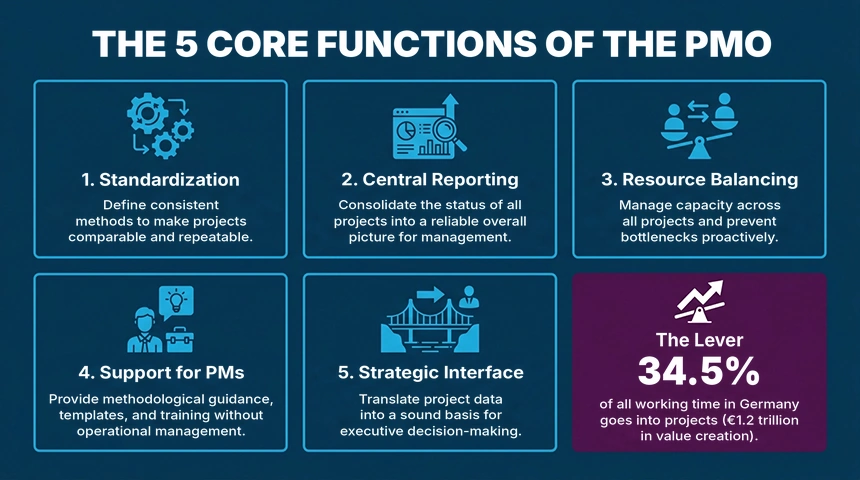
The function of a PMO is to centrally coordinate and standardize project management activities. The Project Management Office is the overarching control and support authority for all of a company’s projects.
As a central point of contact, the PMO bundles all project management events (activities) and ensures that all projects follow the same methods and standards. Its most important contribution is a uniform database, a so-called single source of truth, which creates transparency about the status, schedules, costs, and resources of all projects. Instead of assuming operational responsibility, the PMO provides methods, templates, and standards, thereby enabling project managers to control their projects independently and in line with uniform standards.
The importance of this central control function is reflected in the significance of project work in the German economy. According to surveys by the German Association for Project Management (GPM), more than 34.5 percent of total working time is now spent on projects, which corresponds to a gross value added of around 1.2 trillion euros. The more value is created in projects, the greater the business need for a coordinating authority such as the PMO.
- Standardization of Methods: The PMO defines uniform procedures so that projects become comparable and repeatable.
- Central Reporting and Transparency: It consolidates status information from all projects into a reliable overall picture for management.
- Resource Coordination: The PMO balances capacities across all projects and prevents bottlenecks.
- Methodological Support for Project Managers: It provides templates, training, and advice without taking over operational leadership.
- Interface to Executive Management: The PMO translates project data into a sound basis for decisions on strategic control.
What Activities Does a PMO Perform?
The PMO activities are distributed across three levels, ranging from strategic portfolio alignment and governance to operational controlling and support activities.
How extensive these activities are in individual cases depends on the type of PMO and the maturity of the company. A new PMO often focuses on operational fundamentals, while an established unit increasingly takes on strategic and governance-related responsibility. However, recurring core activities run across all levels.
- Standardization of Methods and Processes: The PMO establishes uniform process models, templates, and workflows that guide all projects.
- Project Controlling and Reporting: It monitors schedules, costs, and progress and condenses the results into meaningful reports.
- Resource and Capacity Planning: The PMO coordinates the deployment of employees and funds across all projects.
- Portfolio Alignment and Prioritization: It evaluates projects according to value contribution and risk and supports the selection of the right proposals.
- Project Governance and Compliance: The PMO defines rules, roles, and decision-making paths and ensures compliance with them.
- Training and Coaching for Project Managers: It continuously develops the methodological skills of those responsible for projects.
- Provision and Maintenance of Tools and Templates: The PMO ensures appropriate tool support and keeps templates up to date.
What Strategic Activities Does a PMO Take On?
Through strategic activities, the PMO bridges the gap between the operational project landscape and overarching corporate goals. The PMO consistently aligns the project portfolio with the corporate strategy and ensures that scarce funds flow into the proposals with the greatest value contribution. As part of portfolio management, i.e., the strategic selection, evaluation, and prioritization of all projects, it provides executive management with the basis for classifying proposals according to value contribution, risk, and available capacity.
In addition, the PMO carries out long-term resource and capacity planning across all projects. Multi-project management is about identifying bottlenecks early and planning utilization months and quarters in advance. This turns a collection of individual projects into a controllable whole that is aligned with strategic priorities.
What Role Does the PMO Play in Project Governance?
Project governance encompasses the rules, roles, and decision-making structures that set the binding framework for all projects. It answers the question of who may make which decisions and by which criteria projects are controlled. As the central project office, the PMO defines and monitors precisely this framework and ensures uniform reporting and compliance standards across the entire project landscape.
Specifically, the PMO establishes escalation paths and decision-making bodies so that problems do not remain hidden but are solved at the right level. It also ensures the traceability of project decisions by documenting when each decision was made and on what grounds. This transparency protects the company from uncontrolled growth and builds trust with clients and supervisory bodies.
What Operational Activities Are Part of the PMO?
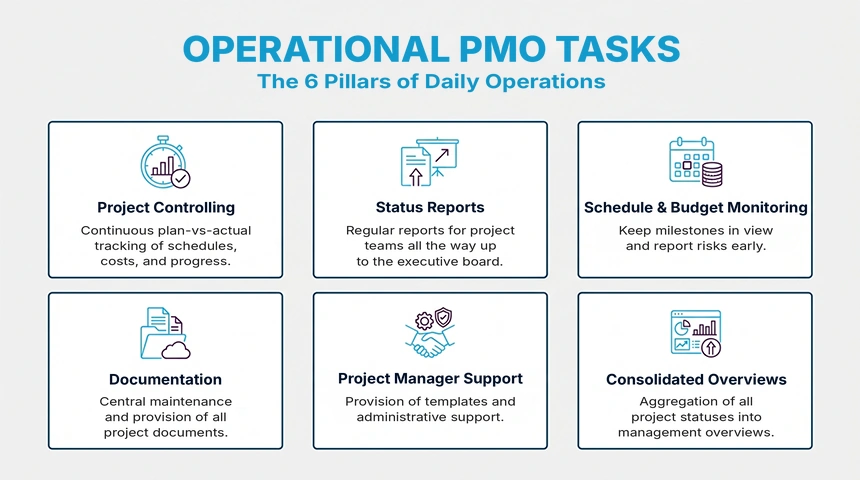
In day-to-day business, the PMO ensures the ongoing control and documentation of all projects.
- Project Controlling: The PMO continuously monitors schedules, costs, and progress (project controlling refers to the ongoing comparison of planned and actual values in a project) and initiates countermeasures in the event of deviations.
- Status Reports and Reporting: It prepares regular reports for different groups of recipients, from the project team to the executive board.
- Schedule and Budget Monitoring: The PMO keeps an eye on milestones and cost frameworks and reports risks early.
- Documentation: It maintains project documents centrally and keeps them accessible to everyone involved.
- Support for Project Managers: The PMO provides templates and reduces the administrative workload for project managers.
- Consolidated Overviews: It bundles status information from all projects into condensed overviews for management.
What Skills Do PMO Employees Need?
The PMO skills comprise a combination of technical, methodological, and social skills, as a PMO usually has to operate without direct authority to issue instructions.
Technical skills:
- Confident use of traditional, agile, and hybrid project management methods.
- Controlling knowledge for evaluating costs, schedules, and progress.
- Knowledge of project management software and reporting tools.
Methodological skills:
- Ability to develop standards, processes, and templates.
- Analytical thinking for interpreting project data.
Social skills:
- Strong communication and facilitation skills when interacting with teams and management.
- Stakeholder management, i.e., the targeted control of the expectations and interests of all parties involved, for greater acceptance.
- Assertiveness, as the PMO achieves its goals mainly through persuasion rather than instruction.
Which Tools and Software Support PMO Work?
Without central project management software, the work of a PMO can hardly be handled efficiently. Only an integrated solution creates end-to-end transparency about the schedules, costs, and resources of all projects.
A PMO needs a system that bundles multi-project management, resource planning, portfolio management, and reporting in a shared database. Real-time overviews, early warning systems, and customizable workflows that enable consolidated control are crucial. Software becomes particularly valuable when it supports traditional, agile, and hybrid methods equally, because a PMO usually oversees different types of projects in parallel.
One solution that meets these requirements is the project management software PLANTA Project for single and multi-project management. Its strength lies in its leading functionality for hybrid project management, developed as software “Made in Germany” with more than 45 years of experience. For strategic project and portfolio management, PLANTA Enterprise is available as an extended edition.
For PMO work, this means central planning, management, controlling, and communication across all projects, i.e., exactly the core activities that a PMO performs every day. Real-time overviews make the status of all proposals visible at all times, early warning systems report deviations in schedules or budgets early, and customizable workflows can be adapted to a company’s individual processes. Resource planning is fully integrated and combines traditional, agile, and hybrid methods in one system.

In practice, the value of a hybrid approach is already evident in individual projects, but it unfolds its full strength in multi-project control. For example, high-level scheduling can be controlled in a traditional way in PLANTA Project, while the operational details are handled by the teams in an agile way using Kanban boards. This allows the PMO to maintain an overview of the entire portfolio without taking away the individual teams’ preferred way of working.
- Full Transparency and Central Control: All projects can be overseen and steered from a single system.
- Better Use of Resources: Integrated resource planning distributes capacities across projects and prevents bottlenecks.
- Flexible Adaptability: The software adapts to existing business processes instead of imposing rigid requirements.
- Available as an On-Premises and Cloud/SaaS Version: Companies choose the operating model that suits their requirements.
What Types of Project Management Office Are There?
The PMO types differ primarily in their level of intervention, which ranges from advisory and supportive to controlling to directive.
- Supportive PMO: Provides templates, best practices, and guidance, and exercises only a low degree of control.
- Controlling PMO: Sets standards and monitors compliance with them, which corresponds to a moderate degree of control.
- Directive PMO: Takes direct control of projects and operates with a high degree of control.
This three-way classification goes back to the Project Management Institute (PMI), which describes three primary governance models in its PMBOK Guide: The supportive PMO as a best-practice repository with low control, the controlling PMO, which demands compliance with defined frameworks, and the directive PMO, which manages projects directly. Which of the three types is suitable depends on the need for control, organizational maturity, and the business-critical importance of the projects. Directive PMOs in particular often take on the strategic prioritization of all proposals, which is closely linked to the strategic orientation of project portfolio management and goes far beyond mere methodological support.
1. Supportive PMO
The supportive PMO acts in a guiding and enabling capacity. It provides methods, templates, training, and best practices without imposing binding requirements on project managers. It therefore has the lowest degree of control of the three models, as project managers retain full autonomy over their own projects. Typical activities include preparing established project management methods and offering them to teams as guidance. This model is particularly suitable for companies with an already mature project culture and little pressure to standardize. Its strength lies in its high level of acceptance, as it is perceived as a service. Its limits become apparent where uniform standards must be enforced, as the supportive PMO lacks the authority to do so.
2. Controlling PMO
The controlling PMO goes one step further and specifies binding standards, methods, and reporting formats, actively monitoring compliance with them. Its degree of control is moderate: Compliance is required, but operational project responsibility remains with the project managers. Typical activities include regularly reviewing project reports based on defined key figures and methods in project controlling in order to objectively assess deviations. This model is suitable for companies that want to actively enforce uniform procedures and create comparable projects. Its strength lies in the reliable comparability and quality of project data. Its limitation is the higher coordination effort, as compliance with the requirements must be continuously monitored.
3. Directive PMO
The directive PMO has the highest degree of control and takes on direct control of projects. It often provides the project managers itself and has full authority to issue instructions regarding project workflows. Typical activities include directly managing projects, including planning, resource deployment, and decisions on priorities. This model is particularly suitable for large companies and for critical or highly regulated projects with a high need for control, such as those found in the pharmaceutical industry or plant engineering. Its strength lies in consistent, uniform end-to-end control. Its limits become apparent in the high resource requirements of the PMO itself and in the risk that project managers’ autonomy is pushed back.
It is precisely at this limit that the greatest risk of failure lies in practice. In our experience, directive PMOs in particular run into difficulties when they are primarily understood as a control and approval authority. In agile-hybrid companies, teams need guardrails and transparency, but at the same time enough room to maneuver for quick decisions. A PMO should therefore provide standards, methods, portfolio transparency, and resource control without unnecessarily centralizing operational decisions.
IIn practice, we see the greatest success with PMOs that act as enablers: they establish standardized processes, reliable data, and meaningful reports so that project managers can make well-informed decisions. It is precisely this balance between governance and autonomy that is crucial, especially in hybrid project environments.
Why Is a PMO Useful in Project Management?
Such a unit delivers the greatest PMO benefits where recurring problems arise in everyday project work. Four triggers most often make the case for introducing one.
- Lack of Overview with Many Parallel Projects: Without a central authority, management loses the overall view of status and dependencies.
- Frequent Schedule and Budget Overruns: Deviations are recognized too late and jeopardize delivery dates and cost frameworks.
- Resource Bottlenecks and Inefficient Utilization: Staff and funds are not coordinated across projects.
- Inconsistent Project Management Standards: Every team works differently, which makes projects difficult to compare.
The more projects run in parallel and the more complex the company becomes, the greater the benefits of a PMO. Especially in resource planning in multi-project management, cross-project coordination often determines whether deadlines are met.

1. Lack of Overview with Many Parallel Projects
When many projects run simultaneously, the overall view quickly gets lost without a central authority, from status and dependencies to priorities. The consequences are duplicated work, overlooked risks, and decisions that are made too late. A solid understanding of the fundamentals of multi-project management helps to put these relationships into perspective. This is where the PMO comes in: It creates a central, consolidated overview of all proposals and makes dependencies between projects visible. This creates the transparency needed for management to make well-founded decisions and identify bottlenecks in good time.
2. Frequent Schedule and Budget Overruns
Without continuous project controlling, deviations in schedules and budgets often only become visible when countermeasures become expensive. The consequences are cost increases, postponed delivery dates, and declining stakeholder confidence. Effective cost planning in project management forms the basis for identifying such developments early. The PMO establishes standardized controlling and early warning systems that make deviations visible early on. This allows corrections to be initiated while they are still effective, and projects remain within the planned time and cost framework much more often.
3. Resource Bottlenecks and Inefficient Utilization
If resources are not coordinated across projects, paradoxical situations arise: In one place there is overload, while elsewhere capacities lie idle. The consequences are delays, overtime, and declining employee satisfaction. A typical resource bottleneck in project management can rarely be solved by short-term staffing increases. The PMO therefore carries out central resource planning, i.e., the forward-looking allocation of staff and funds, and balances capacity utilization across all projects.
A common fallacy exacerbates such bottlenecks further: Adding more staff to a project that is already late often makes it even later, because onboarding takes time and complexity increases. Instead of filling positions in an uncoordinated way, a PMO uses forward-looking, cross-project resource management to proactively ensure realistic utilization.
4. Inconsistent Project Management Standards
If every project manager uses their own methods, templates, and key figures, projects can hardly be compared, and valuable knowledge is lost when employees change. The consequences are time-consuming onboarding, a lack of comparability between projects, and duplicated effort for recurring activities. The PMO counters this by defining and maintaining uniform standards, methods, and templates for all projects. This way, teams work according to a shared understanding, results become repeatable, and the knowledge gained is permanently retained by the company.
What Are the Advantages of a PMO?
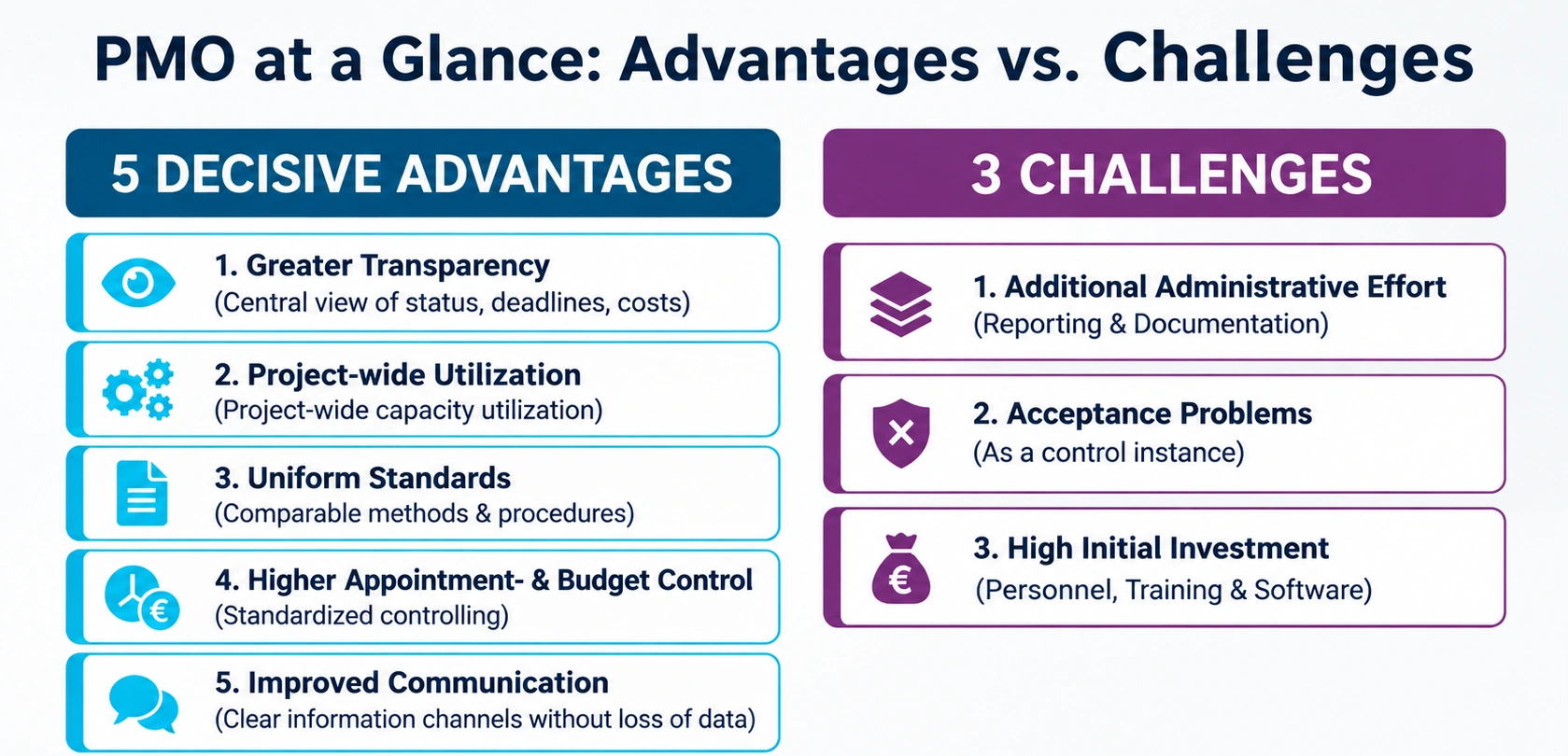
The PMO advantages arise directly from the central bundling of project management. Five effects are particularly relevant and contribute directly to the PMO benefits.
- Greater Transparency Across All Projects: Status, schedules, costs, and risks become visible in a central overview.
- Better Resource Planning and Utilization: Capacities can be optimally distributed across projects.
- Uniform Standards and Methods: Projects become comparable and results repeatable.
- Better Adherence to Schedules and Budgets: Standardized controlling keeps projects within their framework more reliably.
- Improved Communication and Collaboration: Clear information channels reduce friction between the parties involved.
1. Greater Transparency Across All Projects
A PMO consolidates the status, schedules, costs, and risks of all projects into a single, central overview. This overview is created because the PMO combines data from all proposals according to uniform criteria instead of leaving it scattered across individual project files. In practice, this gives decision-makers a reliable overall picture of the project landscape at all times. Risks and dependencies between projects are identified much earlier, so that management can take countermeasures in good time before a small problem becomes a serious threat.
2. Better Resource Planning and Utilization
Through central resource planning, the PMO distributes the available capacities across projects to where they make the greatest contribution. This effect arises because all projects register their requirements in a shared system, and the PMO compares them against actual availability. In this way, overutilization and underutilization balance each other out instead of coexisting. Bottlenecks can be identified early, so that the company can reschedule, set priorities, or procure additional capacities in good time.
3. Uniform Standards and Methods
Uniform standards make projects comparable and their results repeatable. This benefit arises because the PMO provides binding methods, templates, and key figures that guide all teams. In practice, this makes onboarding and knowledge transfer much more efficient, as new employees encounter familiar structures. Well-designed standards include traditional, agile, and hybrid methods equally, so that each team can choose the right approach for its project without losing overall comparability. Hybrid project management in particular benefits from this flexible framework.
4. Better Adherence to Schedules and Budgets
Standardized controlling and early warning systems increase the likelihood that projects stay within the planned time and cost framework. This advantage arises because the PMO continuously measures deviations and makes them visible before they take on a life of their own. Deviations are identified early and can be corrected while the effort required to do so is still low. This noticeably strengthens reliability toward clients and management.
The use of professional multi-project management solutions in practice shows how measurable this effect can be. Uhde High Pressure Technologies (thyssenkrupp) in mechanical and plant engineering provides an illustrative example. There, around 170 parallel customer, service, and R&D projects were previously planned using a combination of spreadsheets and various individual tools. With the introduction of new PMO processes in conjunction with PLANTA Project, schedule and resource planning were standardized, bottlenecks were made visible early on, and cross-departmental prioritization was significantly improved. It is documented that on-time delivery improved significantly and measurably as a result, while planning reliability increased and manual coordination effort decreased noticeably.
5. Improved Communication and Collaboration
The PMO bundles the information flows around all projects and creates clear communication channels between projects, teams, and management. This benefit arises because reports, schedules, and decisions run through a central point instead of getting lost in countless individual coordination efforts. Uniform reporting formats reduce misunderstandings, as everyone involved uses the same language and the same key figures. In practice, this makes cross-departmental collaboration more structured and transparent, which makes all the difference, especially in projects with many interfaces.
What Are the Disadvantages and Challenges of a PMO?
A PMO brings not only advantages but also challenges that should be considered during its introduction. Three of these are particularly relevant in practice.
- Additional Administrative Effort: Reporting, documentation, and coordination require additional processes.
- Acceptance Problems Among Employees: A PMO is often initially perceived as a control authority.
- High Initial Investment and Implementation Costs: Staff, training, and software initially incur costs.
1. Additional Administrative Effort
A PMO requires additional processes for reporting, documentation, and coordination that did not previously exist in this form. If this turns into excessive bureaucracy, the PMO risks being perceived as a brake rather than an accelerator. A common cause of this is the lack of a clear mandate from executive management: Without this mandate, the PMO easily degenerates into a mere “template police” or audit authority that increases administrative effort without helping projects through genuine support and interface functions. The effort can be limited through lean, largely automated processes and suitable software that takes over recurring activities instead of passing them on to the people involved.
2. Acceptance Problems Among Employees
Employees and project managers often initially perceive a PMO as a control authority or as an intrusion into their usual autonomy. A lack of acceptance manifests itself in resistance, in circumventing the prescribed processes, and in incomplete or embellished data that renders reporting worthless. This is where consistent stakeholder management pays off: If project managers are involved early, informed transparently about the goals, and experience visible added value, the perception shifts from controller to supporter. The key is that the PMO can concretely demonstrate its benefits for the teams’ daily work.
A typical turning point occurs as soon as project managers realize that the PMO takes work off their hands instead of creating additional bureaucracy.
An example from the pharmaceutical industry illustrates exactly when this perception shifts. Before the introduction, the Dr. Willmar Schwabe group of companies lacked a transparent overview of around 300 parallel projects; status, resources, and priorities were only partially visible, which made decision-making difficult. After the introduction of PLANTA project, project managers and management had access to the same up-to-date information at all times: Status reports were available centrally, project approvals were standardized, and the project pipeline became transparent. As a result, the role of the PMO shifted from a supposed control authority to a central service for better decisions: Projects were prioritized more deliberately, and schedule adherence improved.
3. High Initial Investment and Implementation Costs
Setting up a PMO requires investments in staff, training, and software that initially strain the budget before any return becomes visible. To make matters worse, the benefits often only become apparent in the medium term, which makes cost-effectiveness difficult to grasp in the initial phase. A step-by-step PMO implementation with clearly defined goals and manageable stages noticeably reduces this investment risk. Those who start with a lean model, demonstrate initial successes early, and then expand the PMO in a targeted manner spread the costs while creating the necessary acceptance for further steps.
Who Is a PMO Suitable For?
Whether a PMO is suitable depends less on the number of employees than on the nature of the project landscape. The following criteria provide guidance.
- Number of Parallel Projects: The more proposals running at the same time, the greater the need for coordination.
- Project Complexity and Dependencies: Highly interconnected projects require overarching control.
- Frequent Schedule and Budget Problems: Recurring deviations signal a need for central controlling.
- Need for Uniform Standards: Where comparability and repeatability matter, a PMO creates clear guidelines.
- Strategic Importance of the Project Portfolio: If the portfolio contributes significantly to the company’s success, professional control pays off.
- Availability of Resources for a PMO: Staff and budget for setting it up must be planned realistically.
In practice, this applies above all to companies with several parallel projects, as is typical in upper mid-sized companies and corporations. A PMO shows its value particularly in industries such as pharmaceuticals, mechanical engineering, and electronics, where projects are complex, regulated, and resource-intensive. This is exactly what the examples of Dr. Willmar Schwabe in the pharmaceutical industry and Uhde High Pressure Technologies (thyssenkrupp) in mechanical and plant engineering show, where a PMO based on PLANTA project created a reliable data foundation for multi-project management for the first time.
From What Company Size Does a PMO Pay Off?
There is no fixed minimum size for a PMO. What matters more is how many projects run in parallel and how strongly they depend on each other. As a guideline, a PMO often pays off from as few as around 20 to 50 employees, as soon as several projects with competing resources are managed at the same time. Its full value in multi-project management then becomes apparent in upper mid-sized companies and corporate groups, i.e., typically in companies with around 50 to 1,200 employees.
Smaller companies can start with a lean, supportive PMO that primarily provides methods and templates. Large companies, on the other hand, tend to benefit from controlling or directive models with a higher degree of control. Suitable software can be used regardless of industry but proves particularly effective for complex requirements in mechanical and plant engineering, the automotive industry, IT and organization, banking and insurance, the pharmaceutical industry, and the public sector.
What Makes a PMO Successful?
A successful PMO is characterized above all by a clear mandate, clearly defined goals, and measurable key figures. Such KPIs (key performance indicators, i.e., performance metrics such as schedule adherence, budget compliance, or utilization rate) make the PMO’s contribution objectively traceable. It is equally important that the PMO is tailored to the respective corporate culture and actual needs instead of imposing a standard model.
The following characteristics define an effective PMO and show what makes the difference between an accepted success factor and an unpopular obligation:
- Clear Mandate: Executive management gives the PMO clear authority and visible backing. Only this mandate from the top gives the PMO the authority to demand standards and initiate decisions without having to fight for its legitimacy at every step.
- Measurable Goals: Defined KPIs such as schedule adherence, budget compliance, or utilization rate demonstrate the value contribution and create commitment. They make the PMO’s benefits objectively traceable and prevent its work from being perceived as a mere cost factor.
- Acceptance: Project managers and management experience the PMO as helpful, not as a hurdle. This acceptance does not arise by itself but grows where the PMO noticeably eases the workload in day-to-day business instead of setting up additional control loops.
- Visible Added Value: The PMO provides noticeable relief in everyday project work, for example through ready-made templates, reliable reports, or forward-looking resource planning. The more concretely teams experience these benefits, the more naturally the PMO is accepted as an established fixture.
Which Success Factors Are Important During the Introduction?
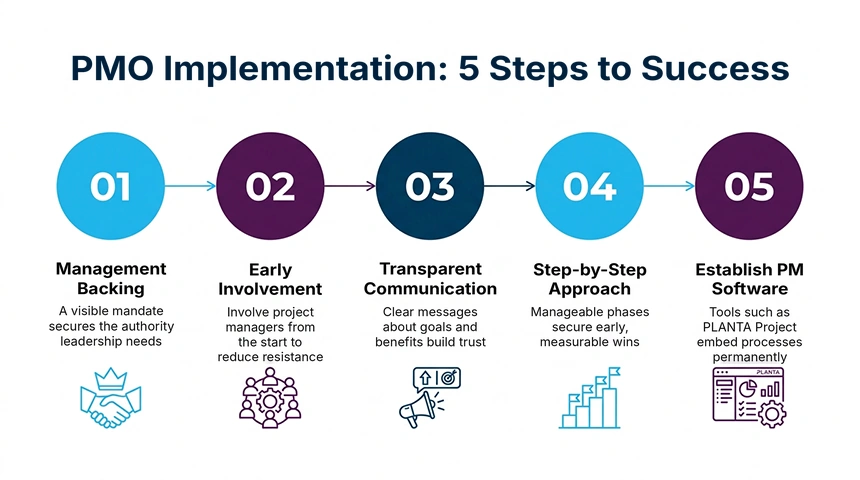
A successful PMO implementation proceeds step by step with clear milestones instead of overhauling the company in a single, hasty step and thereby overwhelming it. Those who build up the PMO carefully and make initial successes visible early gradually win over those involved to the new structures instead of presenting them with a fait accompli. In practice, the following factors determine long-term success:
- Management Backing: A visible mandate from executive management gives the PMO the necessary authority. If the leadership level clearly stands behind the proposal, requirements are taken seriously instead of fizzling out in day-to-day business.
- Early Involvement of Project Managers: Involving those affected from the outset reduces resistance before it arises. Project managers who are allowed to help shape the PMO often later become its most important advocates.
- Transparent Communication: Clear messages about goals and benefits build trust in the proposal. Those who disclose from the outset what the PMO is supposed to achieve, and what it deliberately is not, prevent rumors and false expectations.
- Step-by-Step Approach: Manageable stages with measurable interim goals secure early successes. Each visible step forward provides arguments for the next expansion step and keeps team motivation high.
- Suitable Project Management Software: The right tool support permanently anchors the new processes in everyday work. A solution such as PLANTA project bundles multi-project management, resource planning, and reporting in a shared database and relieves teams of recurring manual work.
Training and coaching accompany this process so that the methods introduced do not merely exist on paper but are actually put into practice. Only when those involved have confidently mastered the new procedures and recognize their benefits in everyday work does a formally introduced PMO become an effective control authority.
What Is the Difference Between a PMO and Project Management?
The difference between a PMO and a project manager lies in the level of responsibility: The project manager takes on the planning, control, and monitoring of an individual project and is responsible for its results, schedules, and budget.
The PMO, on the other hand, is the overarching organizational unit that creates the methodological framework, uniform standards, and cross-project transparency for all proposals.
In practice, conflicts arise above all when the PMO intervenes in operational project management. Successful companies therefore clearly separate the two roles: Project management is responsible for the operational How and the functional delivery of an individual project, while the PMO, as the overarching authority, ensures the structural framework, the methods, and cross-project portfolio control. This clear separation of activities is the basis for smooth interaction.
PMO, Program Management, and Portfolio Management Compared
Project management, program management, and portfolio management differ in focus and level of perspective. The following overview compares the focus and responsibility of the individual disciplines.
| Discipline | Focus | Responsibility | Typical Example |
|---|---|---|---|
| Project Management | Individual project | Project manager | Launch of a product |
| Program Management | Several related projects with a common goal | Program manager | Company-wide transformation program |
| Portfolio Management | All projects as a whole, strategic prioritization | Portfolio/top management | Selection and prioritization of all initiatives |
| PMO | Framework, methods, and transparency for all levels | Project Management Office | Central control and standardization |
Program management controls several projects that are related in content and contribute to a common goal, and it is often organizationally bundled in a program office. Portfolio management, on the other hand, considers all projects as a whole and prioritizes them strategically according to value contribution and risk. The PMO, sometimes also referred to as a project office, is not a competing function but an enabling one. Depending on its type, it operates at the project, program, or portfolio level and supports all three disciplines with uniform methods, reliable data, and common standards.
At What Level Does a PMO Operate?
A PMO can be positioned at the operational, tactical, or strategic level, depending on its type and the mandate given to it by the company. Accordingly, a distinction is made between project-specific PMOs that support a single large proposal, departmental or divisional PMOs, and company-wide units. Such an enterprise PMO, i.e., a central project management office with company-wide responsibility, controls a company’s entire project landscape.
The higher the level, the more strategic control takes precedence over operational support. An operational PMO primarily provides support in day-to-day business, while a strategic enterprise PMO aligns the portfolio with corporate goals and serves executive management as a central control authority.
Conclusion on the Project Management Office (PMO) in Project Management
A Project Management Office centrally bundles, standardizes, and controls project management, thus forming the backbone of a reliable project landscape. This central control creates cross-project transparency, and uniform standards noticeably improve adherence to schedules and budgets. There are three models to choose from: The supportive, the controlling, and the directive PMO, which differ in their degree of intervention. In practice, the most successful PMOs are those that act as enablers and maintain the balance between governance and autonomy instead of unnecessarily centralizing operational decisions. Complex project landscapes benefit most from a PMO, as its value grows with the number and complexity of parallel projects. Which type and setup is right always depends on the size, number of projects, and need for control of the respective company. However, for these structures to work smoothly in practice, the PMO needs the right digital support. Professional tools such as PLANTA project make this step easier: They centrally bring together the traditional and agile data of all teams. If you are about to introduce a PMO and are looking for the right solution, the pricing overview of the PLANTA Project editions provides initial guidance for budget planning.
For decision-makers and project leads in upper mid-sized companies and corporations, a PMO is far more than a theoretical concept. In practice, three steps are particularly important: Selecting the right type of PMO, a step-by-step PMO implementation with clear milestones, and choosing suitable project management software that combines multi-project and portfolio control in one system. Solutions such as PLANTA project and the extended edition PLANTA Enterprise cover exactly this central control across all projects. Those who choose the right type of PMO and plan its introduction step by step lay the foundation for projects that are delivered on time, on budget, and with reliable quality.
Frequently Asked Questions About PMOs in Project Management
What Is Meant by PMO?
PMO (Project Management Office) refers to a central organizational unit that coordinates, standardizes, and supports project management processes across all projects. It creates cross-project transparency and uniform methods, thus forming the overarching control and support authority for a company’s entire project landscape.
What Does PMO Mean in Project Management?
In project management, PMO means that an overarching authority sets the binding framework for all projects, i.e., methods, reporting, and resource control. Unlike the individual project manager, the PMO is not responsible for a specific project but for the cross-project control and standardization of the entire project landscape.
Is a PMO the Same as a Project Office?
Not quite. The term project office is often used synonymously but usually describes a purely administrative support function. A PMO goes beyond this and, depending on its type, also takes on controlling and strategic activities, from standardizing methods to aligning the entire project portfolio.
How Long Does It Take to Introduce a PMO?
Depending on its scope and the size of the organization, introducing a PMO typically takes several months to over a year. A step-by-step approach with clear milestones shortens the start-up time, increases acceptance among those involved, and ensures that the PMO delivers visible added value early on.


Meryem Celik translates PLANTA’s German blog posts into English and is furthermore working on the translation and localization of PLANTA’s project management software into English.


